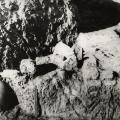
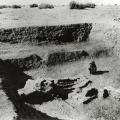
Sink for collection of water in the form of an earthen jar with channel cut out of a brick. A jar, numbered A (f) 160,insitu. Sahni mentions a large earthen jar near a bathing platform in Trench A (f), near the circular structures: “… >
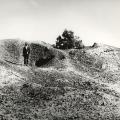
Sahni mentioned the highest mound at Harappa to be ‘the summit of the northern portion of Mound B”. This is one of the views of this portion, with a person, wearing glasses, standing. Of ‘brick-robbing’ at Harappa in the modern times, John Marsha… >
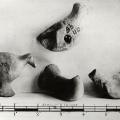
"Animal figures, mostly in terracotta, have been found in very large numbers at Harappa. They are also fairly common in faience, specially the squirrels and rams, both of which were used as amulets. More rarely, they were made of steatite, shell and… >
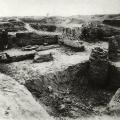
This is a photograph of the same area as in Slide 7, Trench A (e) (Vats 1947, Plate IX), but taken from the northeastern edge of the trench looking north. It shows the excavation of the exterior of the well and many of the fragmentary walls have bee… >
A view of excavations at Trench A (i), Mound F. Deep vertical cutting, mark the sides of the trench, and a labourer is shown, sitting close to the finds of structures, of bricks For a description of the excavations and the finds, including of, th… >
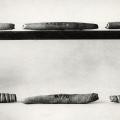
Six long beads, exhibited in two rows of three each. From mounds F and AB. Finds nos. that are noted are: A(e) 99, Ab 692, A(f) 1, B 1543, B 770. Two on either side of the bottom row are of terracotta as they look similar to the one publish… >
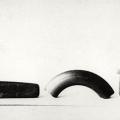
Four objects in a row. Second from right: ? piece of a stone ware bangle (?). NOTE: The find numbers written on the back of the photograph A 528, Ab 635, AB 1076, B4. >
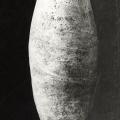
This form of tall flaring cylindrical vessel was probably used as a drinking vessel. Seven of these tall jars (referred to as oval jars) were found in a row and many had smaller cylindrical jars inside them. It is possible they were being stored in … >
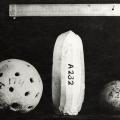
"Balls in terracotta, stone, shell, and faience have been found universally at Harappa, those in terracotta being recovered in specially large numbers." >
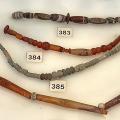
The long carnelian beads at the bottom of this image are among the most distinctive products made during the height of the ancient Indus civilization. Dr. Kenoyer writes (Ancient Cities, pp. 162): "Many of the long carnelian beads were traded as … >