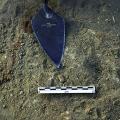
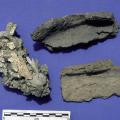
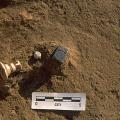
Broken canisters, often with glassy vitrified surfaces, were found throughout the Trench 54 South workshop debris. Lumps of frothy faience slag with embedded fragments of bone were also quite common in the debris. >
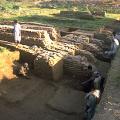
Baked brick drains and possible doorways were missed by brick robbers in Trench 57 West. The massive mud brick platforms may have served as foundations for houses. >
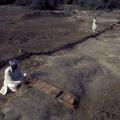
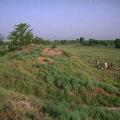
Excavations along the northeast perimeter of Mound F (Trench 41NE) identified traces of a massive mud-brick wall that protected the interior settlement (to the left) from floods and unwanted visitors. This perimeter wall of Mound F was buried under … >
Collection of reconstructed pottery from the late levels of Trench 43. These shapes include the final Harappan forms (late Period 3C) and transitional Late Harappan period shapes (Period 4). >
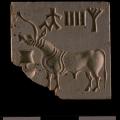
Unicorn seal (H2000-4500/10007-01) after conservation. Note the deeply chiseled engraving of the script similar to that found particularly on Period 3C rectangular seals. >
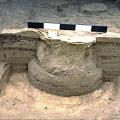
Normally in archaeology pits are emptied before earlier surrounding layers are excavated. In this case, however, in order to expose vertical sections of both the Ravi phase pit and of the earlier deposits, excavation of the floors around the pit… >
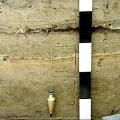
After excavation, the section view of the Ravi phase floors with agate manufacturing debris was drawn and photographed, and block samples were taken for micromorphological study. >