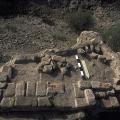
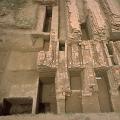
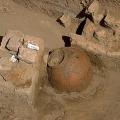
Cemetery H house wall and floor level dating to around 1700 BCE Complete bricks used to make the wall indicates an active brick industry rather than the decline previously assumed. >
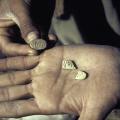
High concentrations of objects such as these terra cotta seal and faience tablets indicate the significance of this part of the site (Trench 54 area) for obtaining further insights on the manufacture and use of inscribed pieces. >
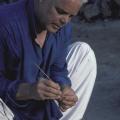
Attempts at replication of ancient techniques through modern experiments (experimental archaeology) is an important part of research at Harappa. Here, J. Mark Kenoyer paints designs on carnelian beads using a solution of calcium carbonate/bicarbonat… >
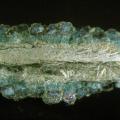
Fiber pseudomorphs preserved by copper salts on the interior of the coiled copper necklace (Slide 38) have been analyzed using various techniques and determined to be silk from the wild silk moth, Antheraea mylitta, commonly called "Tussar" silk tod… >
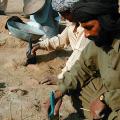
Mohammad Shamoon (black turban) and Abdul Sattar (flowered turban) are highly trained excavators who have worked with the Harappa project since 1986. Here they are carefully uncovering manufacturing debris in Trench 54 South. >
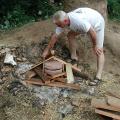
Experimental efforts to manufacture and fire faience and steatite tablets were undertaken by J. Mark Kenoyer in Madison, Wisconsin, during the summer of 2001. >
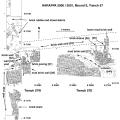
Deep digging at the southeast corner of the "granary" revealed an earlier building [wall 330] constructed along the same east-west alignment. This structure could have been built as early as the beginning of Period 3B, ca. 2450 BC. The currently vis… >
Unique cylindrical object made of maroon and white faience from Harappa (H99-3856/8756-26 from Trench 43, length = 21.9 mm). Numerous examples of this identical type of bead have been found in other parts of Harappa, but this may have been where the… >