
Mundigak @ the Guimet
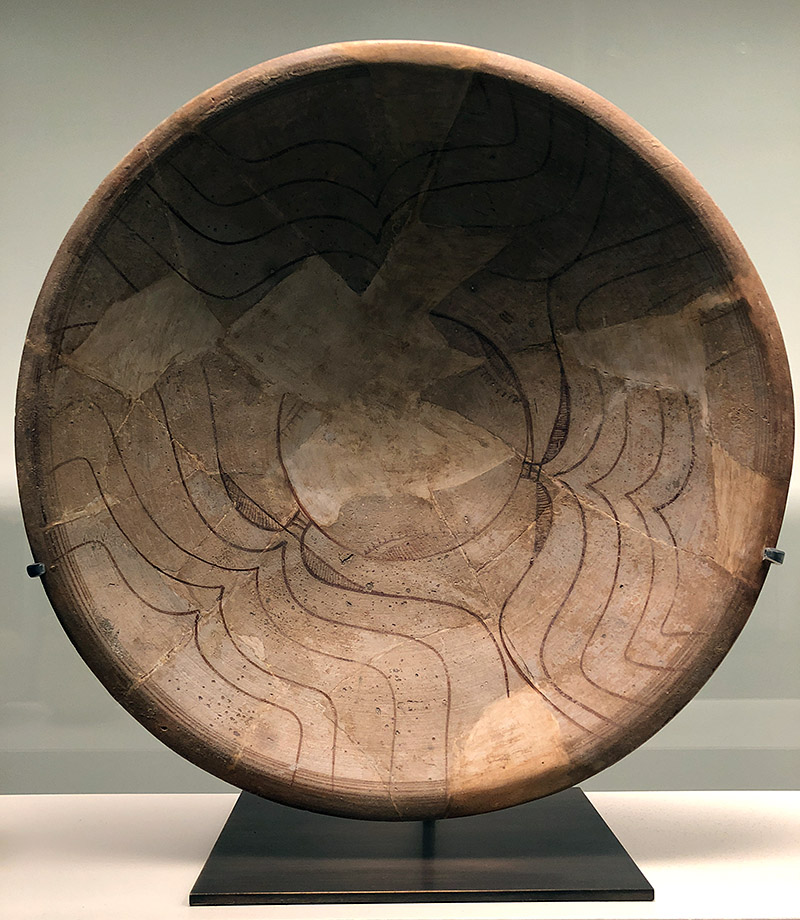
A visit to discoveries from Mundigak, a little-known Bronze Age and earlier [c. 4500-2000 BCE] site in southern Afghanistan. The objects are now at the Guimet, the French National Museum of Asian Art in Paris. Their similarity to objects and motifs in the ancient Indus Valley is remarkable. Examples include the pipal leaf, a rat trap, the humped bull, a bird whistle and classic goblets the Mundigak excavators called "brandy balloons." There is even a stone sculpture which resembles the "priest-king."
This 33 slide section is accompanied with excerpts from the writings of Jean-Marie Casal, who led the excavations at Mundigak in the 1950s, and the writings of other major scholars and archaeologists of the region. There are quotes from the lively on-scene memoir Time Off to Dig by the journalist Sylvia Matheson (1961), historic photographs from the site, and two dozen objects that remain largely unseen except when one visits the Guimet. Best of all, there are new more secure dates for Mundigak Periods I-IV . Finally, exciting new speculations by Massimo Vidale on the "Priest King" and the Mundigak head, and connections between Mundigak Palace and the "hut" motif of the recently discovered Halil Rud Civilization in Iran, are among the 7 new articles added by the world's leading archaeologists filling in recent discoveries.
In the new The Archaeology of Afghanistan authors F. R. Allchin, Warwick Ball and Normand Hammond write: "The Helmand [river] is actually the only major perennial river located between Mesopotamia and the Indus River, and its importance in prehistoric cultural developments throughout this vast area between the Euphrates and the Indus cannot be over-emphasised. The location of Mundigak within the drainage of one of the main tributaries of this system is a major factor in understanding the cultural processes and phenomena which are reflected at this site." (2019, p. 163)
|
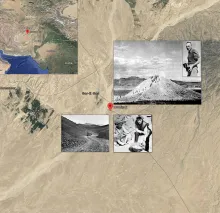
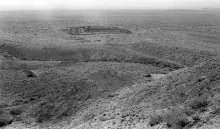
1. Aerial View of Mundigak "Jean-Marie [Casal] pointed. 'There in front you see Siah Sang Pass—that is, Black Stone Pass.' "We had turned north towards a line of low, black mountains splashed with one white patch. As we… |
|
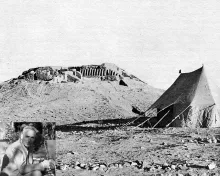
2. Mundigak Mound and Tent "The whole district was known as Kar Karez and the track eventually took us through a village called Mundigak, the name Jean-Marie had borrowed for the mound. High mud-brick walls, square, flat… |
|
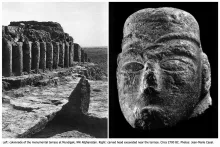
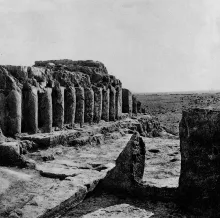
3. Monumental Terrace and Carved Head, Mundigak One of the most exciting developments in recent times has been new chronologies of Mundigak, interesting because they put the palace and head in this picture before the height of the ancient Indus… |
|
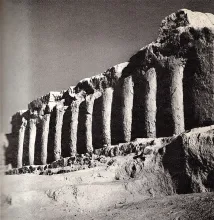
4. Mundigak Palace A decade later, after excavating the pre-Indus site of Amri in Sindh, Jean-Marie Casal published the book La Civilisation d l'Indus et ses enigmes [The Indus Civilization and its Puzzles] (1969). In… |
|
5. Mundigak Palace II "We must therefore consider the ‘ramparts’ as monumental structures in much the same way as the ‘palace’ and ‘temple’ are, part of an overall monumentalisation of Mundigak that marks Period IV. The… |
|
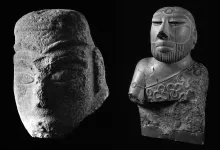
6. Mundigak Head and the "Priest King" What are the similarities between these this white limestone head found at Mundigak in southern Afghanistan and the so-called "Priest King" from Mohenjo-daro? Massimo Vidale offers a fascinating… |
|
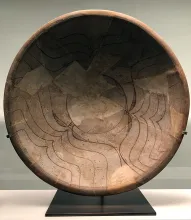
7. Painted Bowl This painted bowl at the Guimet is from the Mundigak IV period, 2900-2400 BCE and involves some elaborate and very finely painted designs that could be an abstraction of the pipal leaf, sacred or of… |
|
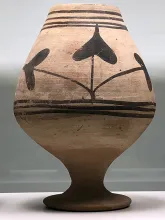
8. Pipal Leaf Goblet "These balloon glasses are characteristic of the urban period [Period IV]. Most often, their decor includes either rows of caprids with an elongated body and hatching in the Iranian style of Susa II,… |
|
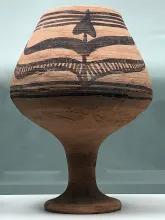
9. Pipal Leaf Goblet A painted goblet from Mundigak IV, dated from approximately 2500-2000 BCE. Note the stylized design accompanying the pipal leaf, also seen on the painted bowl opening this series. Bridget and… |
|
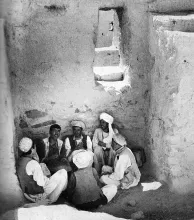
10. Mundigak Palace Original caption by Sylvia Matheson: Shade from the thick, mud-brick walls (which were on stone foundations) excavated in the residential quarter on Mound B provides welcomes relief from the sun's… |
|
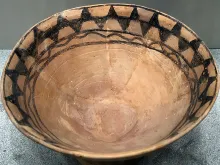
11. Painted Bowl A Mundigak III (3400-2900 BCE) bowl. J.F. Jarrige writes in The Early Architectural Traditions of Greater Indus as Seen from Mehrgarh, Baluchistan "Work conducted at Mehrgarh has clearly shown that… |
|
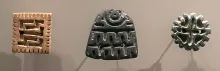
12. Mundigak Stone Seals The center stone button seal is from Period IV (2900-2400 BCE), while the right most stone button seal is similar to ones from Period II (3500-3400 BCE) and Period III (3400-2900 BCE). "Stone seals… |
|
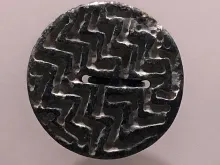
13. Mundigak Stone Seals The wide variety of seals found at Mundigak, mainly stone but also some copper, have deep material and stylistic connections with Central Asia (see two bronze Mundigak seals), and, towards the south… |
|
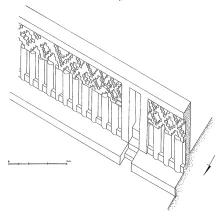
14. The Mundigak Palace Facade and "Hut" Motif from Jiroft "Two massive mud brick stepped buildings of the mid 3rd millennium BC were actually excavated, one at Tureng Tepe in the Gorgan plain (north-eastern Iran, Deshayes 1997) and a better preserved one at… |
|
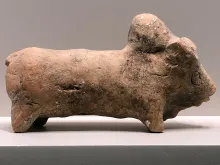
15. Humped Bull Figurine A humped bull figurine, similar to ones also found in Sohr Damb/Nal in Balochistan, with which Mundigak also shared burial customs in Period III [3400-2900 BCE]. Casal writes, after discussing the… |
|
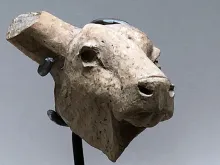
16. Bull's head Jean-Marie Casal writes "Note also that, during their occupation, the first occupants of Mundigak [which he thought were nomads around 4500 BCE, but now is dated more towards 4000 BCE] already how to… |
|
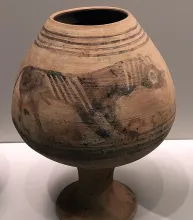
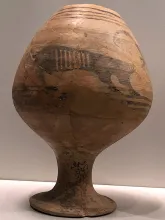
17. Tiger Goblet "For analogies to the distinctive Kulli cattle we may turn northward to Mundigak," writes Sir Mortimer Wheeler in The Indus Civilization "where Period IV (succeeding the 'Quetta ware' of Period III)… |
|
18. Goblet Caprid Casal writes: "Thus, on these tasting glasses then so fashionable, we see represented caprids, in particular, with the elongated body and covered with hatching, whose eye is represented by a point in… |
|
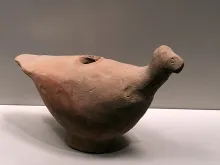
19. Bird Whistle A bird whistle found at Mundigak. Bird whistles are among the most enduring of objects in South Asia, with thousands of years of history behind them as objects of everyday use. Jonathan Mark Kenoyer… |
|
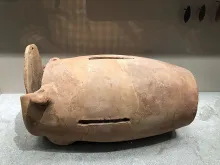
20. Mouse or Rat Trap The caption at the Guimet identifies this as a rat trap, one of two similar ones found at the site. The sliding door on the left would have let a rat or perhaps another creature like a mouse in… |
|
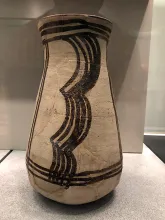
21. Vase Painted pottery from Mundigak IV, dated from approximately 2900-2400 BCE. Casal called it "pottery with geometric decoration." The design is beautiful and alive, of a style current since Neolithic… |
|
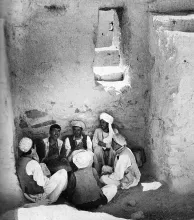
22. Mundigak Houses Sylvia Matheson captioned the above photograph: "Shade from the thick, mud-brick walls (which were on stone foundations) excavated in the residential quarter on Mound B provides welcomes relief from… |
|
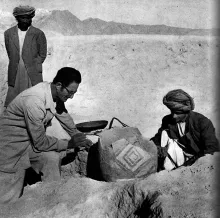
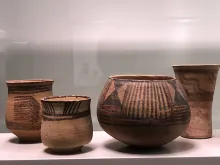
23. Pot Discovery "Ebrahim uncovered a large storage jar on his side of the balk, set at the same level as mine, in the angle of a landing at the top of a little staircase. And what ajar! It was the only one of its… |
|
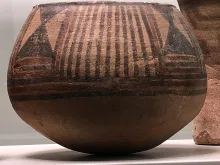
24. Painted Pottery Mundigak III (3400-2900 BCE) and IV (2900-2400 BCE) pottery with geometric designs. Aurore Didier asks in his article The use of colour in the Protohistoric pottery from Pakistani Balochistan and… |
|
25. Painted Bowl Dated to Mundigak III (3400-2900 BCE). In his article The use of colour in the Protohistoric pottery from Pakistani Balochistan and from Mundigak (Afghanistan): Cultural Identities and Technical… |
|
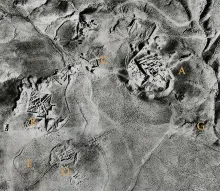
26. Mundigak Mound G "Temple" The "Palace" was not the only monumental structure at Mundigak. There was also a "Temple" as Casal called it, on the adjacent Mound G and built along the same axis towards the latter part of Period… |
|
27. View of the Site Excavations The expansion of Mundigak from Mound A to mounds B, D, E, F, G, H and I all seem to have happened in Period IV (2900-2400 BCE). "West of Mound A, Mounds B and D produced remains of an enclosing wall… |
|
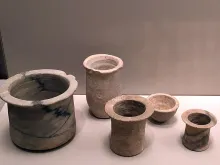
28. Stone Ware 2 More stone ware from Mundigak. |
|
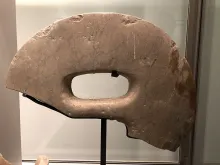
29. Broken Round Object A stone object of unknown purpose from Mundigak. There seem to have been two similar rounded open areas in the center of the circle. |
|
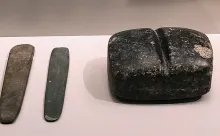
30. Two Objects, one Unknown Whetstones for sharpening copper copper blades. The grooved rock, Jonathan Mark Kenoyer suggests, might have been some kind of polisher. |
|
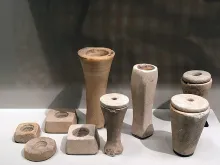
31. Oil Lamps and Small Pots A variety of oil lamps and small pots made of alabaster, as described in the Guimet's caption, were discovered at Mundigak. Alabaster is a soft stone, typically light in color, translucent and easy… |
|
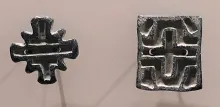
32. Two Mundigak Bronze Button Seals Compare the square seal on right with this button seal found at Harappa. These and the stone seals shown earlier are often called "compartmented" seals, with the backs being either open or closed. … |
|
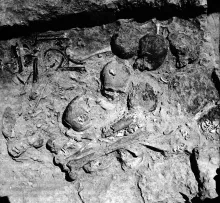
33. Mound C Ossuary This ossuary or collection of bones on Mound C is from the Mundigak Period III [3400-2900 BCE]. Towards the end of Period IV [2900-2400 BCE] , it seems as if the "palace" and "temple" were burned… |
|
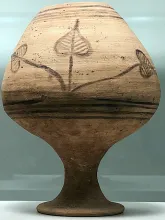
34. Pipal Tree Goblet Jean-Marie Casal writes in his book on the enigma of the Indus civilization, in a section called The last days of Mundigak and the problem of Baluchistan: "In Mundigak, the destruction of the first… |
|
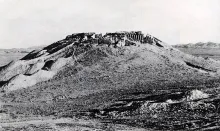
35. General View of the Palace It would have been an imposing site to stumble upon in 2500 BCE. It might have been even more imposing during Mundigak V [up to 1500 BCE?] when another monumental structure was built on top these… |
|
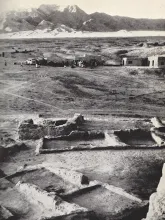
36. Camp from Mound A "The inspection of Mound B a few hundred yards away was left for another day, and we walked down to the square mud-pise boxes that were our cabins. In a hollow between my hut and the main mound an… |