Home

Main navigation

  • home
  • slides
  • essays
  • articles
  • books
  • video
  • q & a
  • blog
Secondary menu
  • about us
    • scholars
    • privacy
    • support
    • image rights
    • credits
    • contact us
  • resources

Granary

Ancient Indus Civilization "granary" excavations and materials. Note that the earlier interpretation of these constructions are Harappa and Mohenjo-daro in particular are not thought of as granaries by modern archaeologists; their purpose remains unclear.

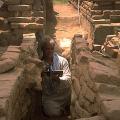
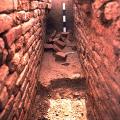
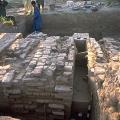
the original forms of the baked brick walls and hollow buttresses of the "granary"

After clearing the overlying silt, the original forms of the baked brick walls and hollow buttresses of the "granary" could be made out. The three high walls in the upper left of the image are part of a later rebuilding of the entire structure after… >

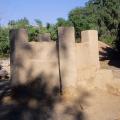
View, After completing the excavation

After completing the excavation, the trenches were filled with sifted sediment and the "granary" structures were covered with a protective plaster made of clay and straw. >

Mohenjo-daro, "Granary" [177B]

  • Mohenjo-daro, "Granary," 1950

REM Granary Wheeler had workmen lifting bags of grain with ropes to illustrate his interpretation of the loading dock at the north edge of the so-called "granary". The square voids in the wall face would have been where wooden beams were inserte… >

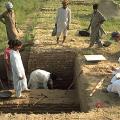
Clearing outside the southeast corner of the "granary"

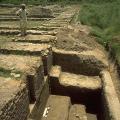
Clearing outside the southeast corner of the "granary" revealed the underlying mud-brick platform and the top of the baked brick revetment. >

Great Bath and Granary, SD Area

  • Mohenjo-daro, Great Bath and Granary, SD Area

The Great Bath is situated along a north-south street with a drain covered with limestone blocks. In the background is the so-called Granary, while in the foreground are the walls of several domestic structures. >

Mohenjo-daro Granary Room [95]

  •  Mohenjo-daro Granary Room

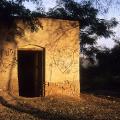
REM Granary Overview of a small room and passage way with sockets for holding vertical wooden beams. The beams were wedged in with smaller brick fragments to holt them tightly in the sockets. No. 95 also 1105 pencilled in >

Aerial view of the exposed southeastern portion

Aerial view of the exposed southeastern portion of the "granary" structure shows the nature of brick bonding and the empty sockets that would have held wooden beams and supports. >

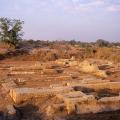
Great Bath and Granary, SD Area, looking west from the stupa mound

  • Mohenjo-daro, Great Bath and Granary, SD Area, looking west from the stupa mound

The great bath surrounded by a brick colonnade, measures approximately 12 meters north-south and 7 meters wide, with a maximum depth of 2.4 meters. In the background is a massive brick structure with narrow passages that was first identified as a ha… >

Mohenjo-daro Granary Wheeler Excavations [163 A]

  • Mohenjo-daro Granary Wheeler Excavations

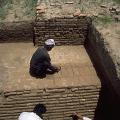
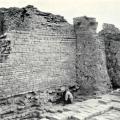
REM Granary Workmen are seen at different levels of the so called granary structure to provide scale for this massive building. The upper worker is sitting in a narrow walkway between blocks of brick foundations. The middle worker is standing nex… >

Photographing the southeastern portion

Richard Meadow photographing the southeastern portion of the "granary" structure. >

Pagination

  • Page 1
  • Page 2
  • Page 3
  • Page 4
  • Page 5
  • Page 6
  • Next page
  • Last page
© Harappa.com 1995-2026 31