Home

Main navigation

  • home
  • slides
  • essays
  • articles
  • books
  • video
  • q & a
  • blog
Secondary menu
  • about us
    • scholars
    • privacy
    • support
    • image rights
    • credits
    • contact us
  • resources

Excavators working at ancient Indus Valley civilization sites.

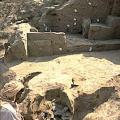
Excavations at the corner of the "granary" area

Excavations in 1997 at the southeast corner of the "granary" area were undertaken to recover a full sequence of pottery, architectural features, and inscribed objects. Here workers have found a seal near the base of the excavations in Trench 41NE th… >

Outlining a Ravi phase storage pit

Each Ravi phase stratigraphic layer was identified and excavated, and the many rodent holes, obvious both in the exposed area and in the section, were isolated. Here delicate trowel work has revealed the circular outlines of the top of a storage pit. >

Small Quarries

Small workshops are represented by small scattered groupings of flint, including flakes, blades and sometimes cores. >

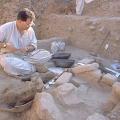
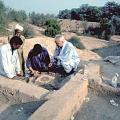
Trench 11

Excavations in 1998 expanded the area of Trench 11 which lies to the west of Trench 10 on Mound E in order to recover seals and inscribed objects inside actual houses. Richard Meadow (HARP Project Director) discusses some finds with Afzal Khan (Depa… >

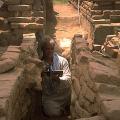
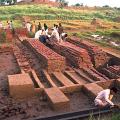
Baked brick revetment of the "granary" platform

J. Mark Kenoyer sitting in the right foreground takes notes during excavations at the southwest corner of the "granary" (Trench 1SW). The baked brick revetment of the "granary" platform is in the foreground, the southernmost baked brick wall of the … >

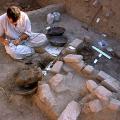
Excavating Ravi phase bead debris

J. Mark Kenoyer assisted by Peter Eltsov carefully uncover and mark Ravi phase bead manufacturing debris in preparation for mapping and photography. >

Balloon

During the surveys, a Castiglioni Brothers helium balloon was employed to take photographs from various altitudes. Thanks to this technique, 800 slides and black and white photographs were taken in five days. >

Eastern edge of Mound E

Clearing the ancient Harappan debris from the eroded surface outside of the mud brick city wall at the eastern edge of Mound E. In 1997 this area of Trench 11 was cleared to define the stratigraphic sequence between Period 3B and 3C. It was possible… >

Photographing the southeastern portion

Richard Meadow photographing the southeastern portion of the "granary" structure. >

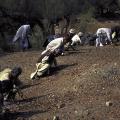
Harappa excavators

After marking, the entire excavation team is called in to map and eventually collect the bead manufacturing debris and all of the sediment from each layer of Ravi phase floors. >

Pagination

  • First page
  • Previous page
  • Page 1
  • Page 2
  • Page 3
  • Page 4
  • Page 5
  • Page 6
  • Page 7
  • Next page
  • Last page
© Harappa.com 1995-2026 31