Home

Main navigation

  • home
  • slides
  • essays
  • articles
  • books
  • video
  • q & a
  • blog
Secondary menu
  • about us
    • scholars
    • privacy
    • support
    • image rights
    • credits
    • contact us
  • resources

Excavators

Excavators working at ancient Indus Valley civilization sites.

Mound E perimeter wall excavations

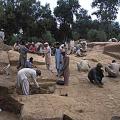
  • Mound E perimeter wall excavations

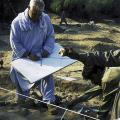
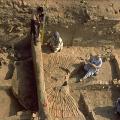
In 2001, excavation of perimeter wall [250] was extended to the Northwest. Here the surface of the wall is being cleared and the bricks outlined. Note the excavation in the foreground left where there was no mud-brick. These regularly spaced rectang… >

Terra cotta necklace find

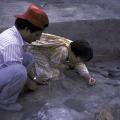
  • Terra cotta necklace find

Conservators very carefully excavate and consolidate a necklace of terra cotta beads found in the Ravi Phase levels at Harappa in 1998. On the left is Arif Husain of Karachi University assisting Elizabeth Robertson of the Smithsonian Institution. >

Triangulation

  • Mark Kenoyer triangulating

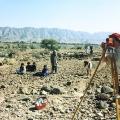
The locations of all important artifacts from Trench 54 South were carefully mapped using standard triangulation methods supplemented by printouts of digital overviews. >

Excavating and sampling the sediments

  • Excavating and sampling the sediments

Jonathan Mark Kenoyer excavating and sampling the sediments associated with the HARP-excavated platform, which was partly robbed of baked bricks during the Harappan period itself (Trench 43). Pottery found under the platforms permits them to be assi… >

Petra at the level at Murda Sang

  • Petra at the level at Murda Sang

Petra at the level at Murda Sang. >

Button seal find

  • Button seal find

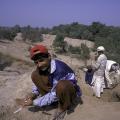
The discovery of a button seal is always exciting. Mushtaq, one of the excavation assistants from Harappa Town is proud to have found the second seal of the 1998 excavation season. >

Newly discovered steatite tablet

  • Newly discovered steatite tablet

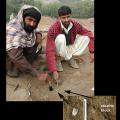
Mohammad Sahmoon (left) and Saeed Ahmad with newly discovered steatite tablet and raw steatite block from Trench 54 South. >

Greenish clay layers

  • Greenish clay layers

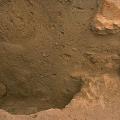
Greenish clay layers were found in a deep depression in the center of the HARP-excavated platform. One theory that is being investigated is that the platform and the central pit were used for production of indigo dye (Trench 43). >

Team 1998

  • Team 1998

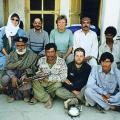
Team 1998. >

Sealing find

  • William Belcher

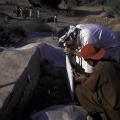
One of the most exciting discoveries of the 1998 excavation season was finding a seal impression or sealing in a hearth of the Early Harappan Period (Kot Diji Phase, circa 2800 BCE). Here William Belcher is seen photographing the important discovery… >

Pagination

  • First page
  • Previous page
  • Page 1
  • Page 2
  • Page 3
  • Page 4
  • Page 5
  • Page 6
  • Page 7
  • Next page
  • Last page
Large unicorn seal
© Harappa.com 1995-2026 31