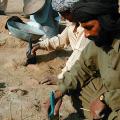
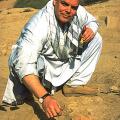
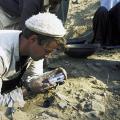
Mohammad Shamoon (black turban) and Abdul Sattar (flowered turban) are highly trained excavators who have worked with the Harappa project since 1986. Here they are carefully uncovering manufacturing debris in Trench 54 South. >
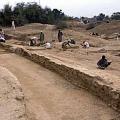
Workmen are cleaning the Trench 11 area in preparation for photography during the 1997 excavation season. Perimeter wall [250] is on the left. The curtain wall in the center was constructed to retain trash that was thrown over the perimeter wall int… >
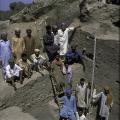
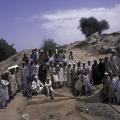
J. Mark Kenoyer (top center, arm outstretched) and excavation team gather at the edge of Trench 39 South at the end of the excavation season. Over the past twelve years many of the local workmen from Harappa and surrounding villages have become extr… >
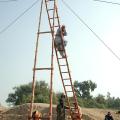
J. Mark Kenoyer using the bamboo ladder to get an overview of the excavation area in Trench 54 South. Photography is done using digital, film, and video cameras. >
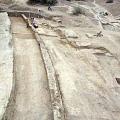
The Trench 11 area showing the perimeter wall (on the left), the curtain wall, and the Period 3C drain that cut deeply into the Period 3B deposits (see the labeled plan in 72). The sediments outside of the perimeter wall are hard packed ashy debris… >
The 1998 excavation crew of the Harappa Archaeological Research Project. Seated at the front left are Mohammad Afzal Khan, representative of the Department of Archaeology, Government of Pakistan, Dr. Jonathan Mark Kenoyer and Dr. Richard H. Meadow… >
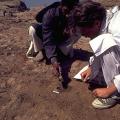
Randy Law, a graduate student from the University of Wisconsin - Madison assisted with the excavation and documentation of Trench 54 South. Here he is using a digital camera to take close up images of manufacturing debris. >
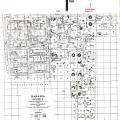
Plan of Vat's excavations showing circular platforms. In some cases remnants of the baked brick walls that probably surrounded each platform can be seen on the plan, although earlier and later walls are also shown. From M.S. Vats (1940) Excavations … >