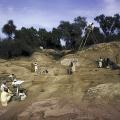
Four Harappan workshops were excavated, including site 480 from which more than 35,000 artefacts were collected. Most of them were debitage flakes, but also included narrow blades, bladelets and accurately made bullet cores. >
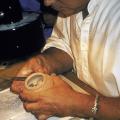
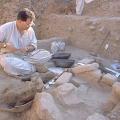
Careful excavations of the pot by J. M. Kenoyer required several weeks. This was done in the evenings after other excavation lab work was finished. The pot and its contents were photographed before and after each layer was removed. (Photo by Manabu … >
In addition to documentation with still photography, J. Mark Kenoyer videoed the "granary" areas excavated and narrated details of the stratigraphy and of the brick construction. >
I currently work as a forensic anthropologist and archaeologist for the U.S. government. I am also the Assistant Field Director of the Harappa Archaeological Research Project (HARP) in central Punjab, Pakistan. Between 1992 and 1995, I studied vario… >
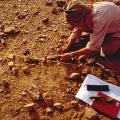
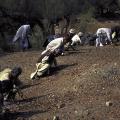
Excavations in 2000 on the west side of Mound E (Trench 54) began with surface collecting to recover any significant artifacts including inscribed objects and craft indicators. >
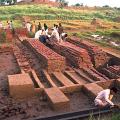
After completing the excavation, the trenches were filled with sifted sediment and the "granary" structures were covered with a protective plaster made of clay and straw. >
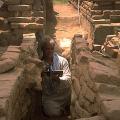
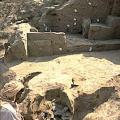
REM Granary View looking south along the western edge of the REM Granary excavations. Multiple rooms were exposed erodiing from this part of the mound. They would have been aligned along a large north-south street and drain that was revealed duri… >
Richard Meadow photographs the excavations in Trench 54 from a tall bamboo ladder that is supported by four ropes. This ladder can be situated over any area of the excavations to obtain near vertical views of rooms and artifact scatters. >

![Mohenjo-daro REM Granary Excavations [1176]](/sites/default/files/styles/square_thumbnail/public/slides/i-1176.jpg?itok=MMSC7WFJ "Mohenjo-daro REM Granary Excavations [1176]")