Home

Main navigation

  • home
  • slides
  • essays
  • articles
  • books
  • video
  • q & a
  • blog
Secondary menu
  • about us
    • scholars
    • privacy
    • support
    • image rights
    • credits
    • contact us
  • resources

Harappa

Harappa, Punjab ancient Indus civilization excavations, figurines, seals and other objects.

A collection of beads

This collection was found from the eroding surface of Bawani, a site not far from Harappa that dates from the 3rd century BC. The red brown beads are glass beads of the Early Historic Period showing a continuity with the glazing technology of red fa… >

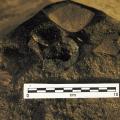
Copper razor

A copper razor (H2000/2164-01) was found in the debris layers at the edge of the kiln dump in Trench 54. Wrapped with fibers, pseudomorphs and impressions of which are preserved in the in the corroded copper, this type of curved razor may have been … >

Tiny gold droplet

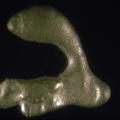
This tiny droplet of gold appears to be a placer nugget, possibly obtained by panning for gold. (H2000-4410/2102-08, Mound E, Trench 54). >

Broken faience beads

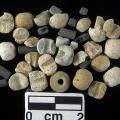
Many broken and some complete faience beads of different colors were recovered in the eroded surface layers of the slope on the south side of Trench 54. >

Inscribed steatite tablets

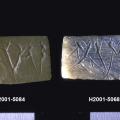
Inscribed steatite tablets made from two different colors of steatite have the same inscription. The sloppy nature of the inscription may be the reason why these tablets were discarded. Both tablets, incised on one side only, were found in the same … >

Harappan and early Harappan walls

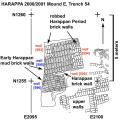
Top plan view of Harappan (Period 3) and Early Harappan (Period 2) walls on the west side of Trench 54. >

Excavations at the southeast corner of the "granary" structure

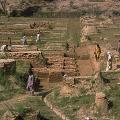
Overview looking north of excavations at the southeast corner of the "granary" structure undertaken in 1999 (Trench 1C). The higher east-west running walls in the left of the image and the ruined structures in the right of the image all post-date t… >

Looking toward the interior of the "granary" structure

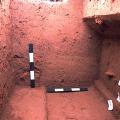
Looking toward the interior of the "granary" structure, the void of the original baked brick wall (vertical scale) is filled with small pieces of broken baked bricks and mud-brick rubble, while the original open space between the walls (horizontal … >

Detail of terracotta tops

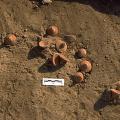
Detail of terracotta tops found in Room 202 (Trench 43). >

Harappan Kiln

Period 4 (Late Harappan transitional) kiln with hollow lower fire box and arched floor with holes for allowing heat to enter the upper firing chamber. This type of kiln was introduced at Harappa ca. 1900 BC and allowed the potters to reach higher te… >

Pagination

  • First page
  • Previous page
  • …
  • Page 22
  • Page 23
  • Page 24
  • Page 25
  • Page 26
  • Page 27
  • Page 28
  • Page 29
  • Page 30
  • …
  • Next page
  • Last page
© Harappa.com 1995-2026 31