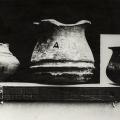
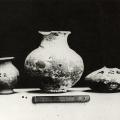
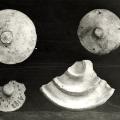
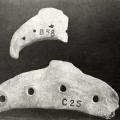
Three more examples, all from Mound F, of what Daya Ram Sahni immediately identified as inkpots. "The other portable antiquities recovered in this Mound F, though not numerous, all point to a high antiquity. A number of terracotta figurines were … >
Daya Ram Sahni found objects he quickly called "inkpot[s] of the shape used in old type Pathsalaif and maktabs to this day" (p. 13). One of these was found in Trench C – "No. C. 2 has three holes in the mouth for the string" (p. 13… >
A number of miscellaneous objects emerged during excavations on Mound F, which contributed the majority of artifacts catalogued in the 1921 ASI report by Daya Ram Sahni. Among these were what he called lids and covers for crucibles – "shallow bowls … >
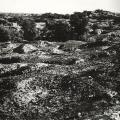
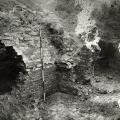
In addition to the excavations at Mound F and Mound AB, Daya Ram Sahni had this photograph taken in 1921 of Mound E [Map, Image 2 above, although this is not considered very accurate today]. Sahni noted in another area how extensively the site had b… >
Daya Ram Sahni continues his narrative after the ringstone discussion on the Mound AB excavations: "The floor level of the building referred to above was reached at the depth of about thirteen feet below the surface of the mound. The portion of t… >
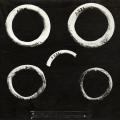
Among the objects found in the large earthen chati [A 233] and a second example which would have been most familiar to Daya Ram Sahni were "earthenware bangles of various sizes were found in large abundance. A few complete specimens were fo… >
Another class of objects, even if incomplete, were also immediately familiar to Day Ram Sahni: "(16) An earthen instrument for making twines. It is a curved shaped piece with five holes, one of which is broken off. Each hole received a strand, al… >
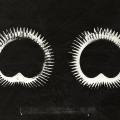
He continues, about perhaps one of the finest objects he found in 1921: "One pair of them attains a high degree of excellence. It is made of fine clay coloured blue. (No. A 182.) Plate IX, Photo No. 2759." - Daya Ram Sahni, Annual Progress Re…>