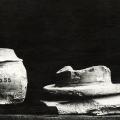
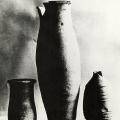
The lid on the left – "shaped like a vase" – shows how varied these objects interpreted as covers could be, including the complex "dish cover" on the right. Sahni concluded, of which these objects fall into the first category: "The excavations we… >
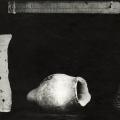
Sahni recognized the object on the right [C 2]as linked to twining as well:"A conical-shaped object with a hole in the base which might have held a wooden stick. Such instruments are used for twining the sacred thread" (p. 13). In the middle is what… >
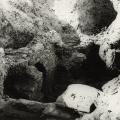
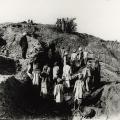
"A second trench was started in the western portion of this mound, but I was so completely bewildered by the enormous accumulations of earth that had to be cleared away that it appeared futile to continue it at the present stage." At this point S… >
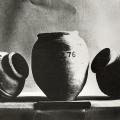
In the large earthen chati, more commonly called a globular pot today, were found what Sahni called lotas, used colloquially to designate drinking vessels, and are now referred to as pointed base goblets though these are not the exact ones found in … >
"The pottery found at Harappa is of the light red or brown colour, excepting some specimens which are black. The latter colour is produced by the application of a variety of earth after it has been fired once." >
"My operations did, indeed, reveal portions of a large brick building, but unfortunately they were found to have been so badly hacked about by brick diggers that it is well nigh impossible to determine its real nature or date, Plate VIII, Photo. N… >
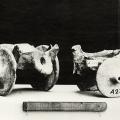
The wheel (A 233) was found inside the large earthen chati unearthed in the first long trench on Mound F. "(21) The only other kind of toy is a cart (Plate X. Photo. No. 2749) consisting of a shallow rectangular basin with rings for the ends of t… >
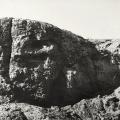
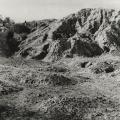
"The mounds at Harappa are a prominent landmark in the countryside visible long distances away. They were visited by Masson in 1826, by Burnes five years later, and by General Cunningham twice in 1853 and 1856. Burnes estimated the extent of the rui… >
In his 1921 summary of pottery finds, Daya Ram Sahni called out "earthenware rests for dishes or pitchers" of which this one was considered the prime example (p. 13). "This type of ring stand was made to support large jars with narrow or rounded … >
"The excavation of the mounds F and A and B was commenced in the beginning, of January 1921, and continued up to the middle of February. The operations were carried on under my personal supervision . . ." wrote Sahni (p. 9), but it is unclear if tha… >