
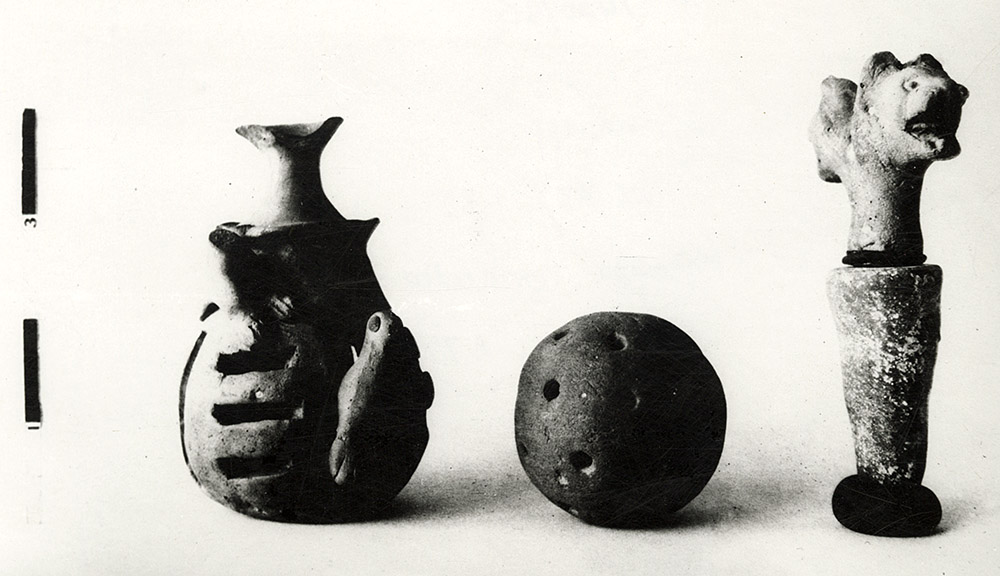
Left: Terracotta Birdcage. Find no. Ab 554. Published in Vats 1940 (Vol. II) Pl. CXX, no. 22.
Middle: a round dice, or a ball, with holes on surface. Find no. 5859.
Right: Double headed terracotta bust of lion on a cone. Published in ARASI 1924-25, Pl XXVII, f. (with the cone). Sahni’s find no for the object. A 813.
The object published in Vats 1940 (Vol. II) no. 88, without the cone. Find no. given A 815 (see Vats 1940, Vol. I, p. 308).
The birdcage and the double headed lion head were found from the area of parallel walls and Sahni noted:
“The portable objects found in this area were numerous. They include a double-headed terracotta bust of a lion (A.813—height 2", Plate XXVII,f) which must have been mounted on a cone of the same material (as shown'. in the photograph) and presented as an offering at a temple. Not far from Punjab this was found a deposit of oval-shaped tablets of alabaster with cracked surfaces. They measure about 4 ½ x 3 1/8 ". The exact purpote [sic] of these tablets is not known, though it is not impossible that like the Sumerian literary tablets they were intended to bear similar inscriptions. At the same spot was found a broad copper chisel 3 3/4" long by 2" wide which must have been used for planing wood. It is badly corroded on one side but has a figure resembling a bull chased on the other side. Other objects found in this area were a copper nail extractor; several seals with the usual device of a unicorn and a pictographic inscription ; a large copper chisel (Ae. 342) measuring 8 ¾ " long by 2" wide with a broad cutting edge and a potsherd showing a peacock and a hen facing each other, a part of a quadruped, and a snake (Ab. 207) ; a miniature earthen pan of a jeweller’s weighing scale (Ab. 188) ; part of a steatite undulating ring (Ab. 193) coated with white faience; a pierced vase-shaped earthen cage (Ab. 554) with a bird coming out of it, and another perched on the side” (Daya Ram Sahni, ARASI 1924-25, p. 76-7)
Vats described the bird cage as pear shaped and the best preserved. He noted:
“Five pottery toy cages have been recovered at Harappa, four from Mound F and one from Area G. They are of two shapes, viz., pear-shaped and oval. No cage has yet been reported from Mohenjodaro. Of the pear-shaped cages. No. 22 (Ab554) is the best preserved. It shows two birds, one coming out of an opening and the other perched on the outside wall. The cage is pierced with three vertical openings, alternating with sets of three horizontal slits. Ht. 3.9 in. Mound F, Great Granary Area; Depth 4 ft. 6 in. b.s.; Stratum II.” (Vats 1940, p. 453)
Of game objects Vats noted:
“Objects used for games are not many. Those that may be said to be unmistakable are balls and marbles in stone, shell, faience and pottery; dice of the same materials except shell; and some gamesmen of tetrahedral or chessman shape, the latter hardly distinguishable from baetyls…. Now-a-days, in the Panjab, many of the most popular games are played with objects of wood which is of course a perishable material. Such are gulli-danda, dand-palam, gaindi, and turning tops (lattu), on the other hand, samundar-tapu or kidi-kada and barah-gati, which are equally popular, are often played with potsherds or pebbles. But even the latter would hardly leave any recognizable traces.”
NOTES:
The ‘Indian’ game names listed by Vats for inferring the kinds of games that might have been played with the excavated objects.
The find numbers written on the back of the photograph A 815, A 554, A 5859.