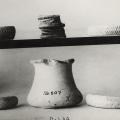
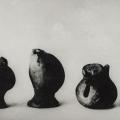
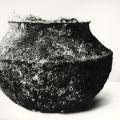
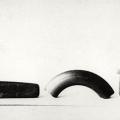
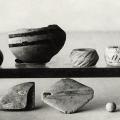
Two rows of six objects, each row has three. Four pieces of bangles, or bracelets, three with fine “incised linear patterns”, to quote Vats 1940, p. 448; Middle bottom row: a pot with find no Ab 607 Middle Top row: misc. Two bangles on … >
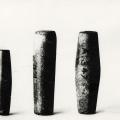
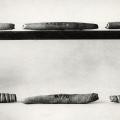
Three long terracotta objects; the find number of the one in the right: A 347. NOTE: The find numbers on the back of the photograph are A 347, B IV 48, AB 81. >
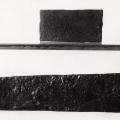
Two copper objects, in two rows. The one on top row has a design etched on it. The one in the bottom row is possibly the copper chisel, which Sahni reported among the finds from Mound F, area of parallel wall: “a large copper chisel (Ae 342) mea… >
Published in ARASI 1924-25, Plate XXVII (i), and mentioned by Sahni as P.II, 13. Title of plate: ‘Terracotta and Other Objects’. Field no. PII-13. Published in Vats 1940, Vol. II, Plate C XXIV, 26; Sketch in Vats 1940, Vol. II, Plate … >
Six long beads, exhibited in two rows of three each. From mounds F and AB. Finds nos. that are noted are: A(e) 99, Ab 692, A(f) 1, B 1543, B 770. Two on either side of the bottom row are of terracotta as they look similar to the one publish… >
Four objects in a row. Second from right: ? piece of a stone ware bangle (?). NOTE: The find numbers written on the back of the photograph A 528, Ab 635, AB 1076, B4. >
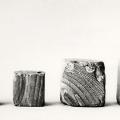
Five cubical weights, possibly all made of chert; find nos. noted: AB 16, B 588, AB 101. From mound AB, and Vats noted that most were found from extensions of Pit I and II (Vats 1940, Vol. 1, p. 361). Vats described the shape as cuboid, and no… >
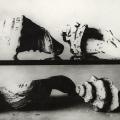
Three cores of a conch shell. Chipped to remove the pieces of the outer shell. Left, bottom row: possibly a ladle. Vats: "Shell was worked with great skill, and every part of it was turned to account in the manufacture of dippers, cups, bangle… >
An assortment of personal ornaments, mostly beads, and a possible nose disc. Bottom row, 1st from left: Described by Vats as “cog-wheel shaped disc”, of which he found three found from Area H, from a burial jar (no. H149, published in Vats 1940, … >