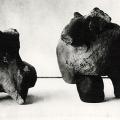
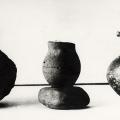
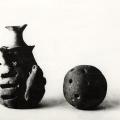
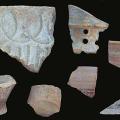
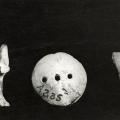
Left: Terracotta Birdcage. Find no. Ab 554. Published in Vats 1940 (Vol. II) Pl. CXX, no. 22. Middle: a round dice, or a ball, with holes on surface. Find no. 5859. Right: Double headed terracotta bust of lion on a cone. Published in ARAS…>
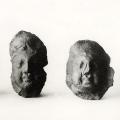
Left to right: three heads of sculptures, cast in terracotta. From Mound AB. Near the surface. Second from left: Published in Vats 1940 (Vol. II) Pl LXXII, no. 58 Third from left: Published in Vats 1940 (Vol. II) Pl LXXII, no. 59 Right: Sea… >
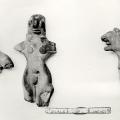
Two terracotta male figurines, nude. Left: Male figurine, nude, published in Vats 1940 (Vo. II), no. 21. Find no. A. 19, 1.7 in high “found at a depth of 2 ft. 6 in. b.s., in Mound F, Great Granary Area, Stratum I” (Vats 1940, p. 296) Vats… >
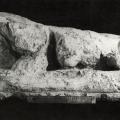
"Base of a terracotta image containing feet of a deity with an uncertain, figure between them (B 54)." - Daya Ram Sahni, Annual Progress Report of the Archaeological Survey [of India], Hindu and Buddhist Monuments, Northern Circle for the Yea…>
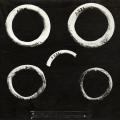
Among the objects found in the large earthen chati [A 233] and a second example which would have been most familiar to Daya Ram Sahni were "earthenware bangles of various sizes were found in large abundance. A few complete specimens were fo… >
It is appropriate that – besides broken seals – among the very first objects that the ancient Indus people represented themselves through four thousand years later were toys. Indeed, it would have been a watershed moment for children in the region a… >
He continues, about perhaps one of the finest objects he found in 1921: "One pair of them attains a high degree of excellence. It is made of fine clay coloured blue. (No. A 182.) Plate IX, Photo No. 2759." - Daya Ram Sahni, Annual Progress Re…>