
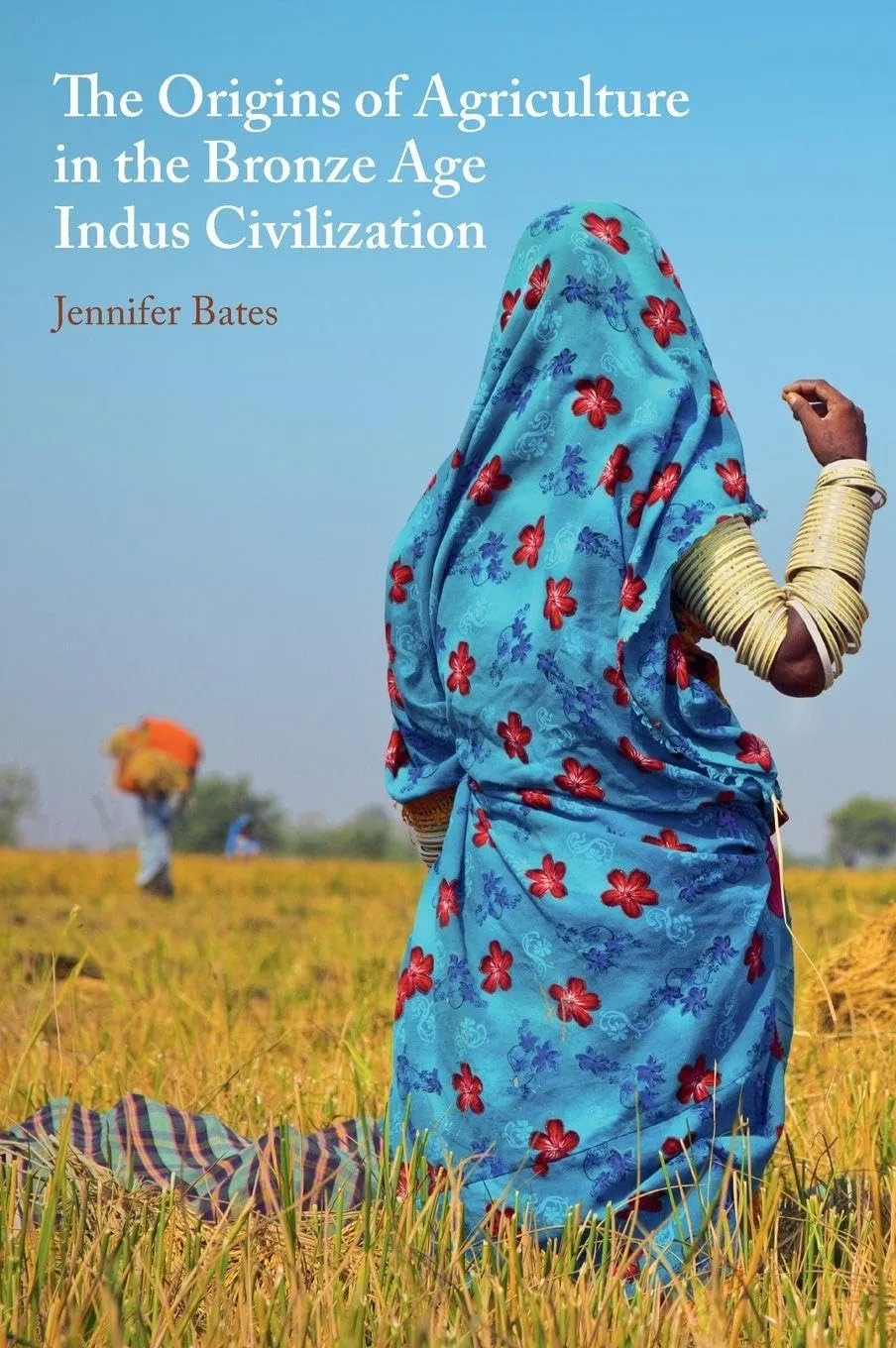
This is a deeply researched and satisfying book, one that takes on fully the point made by Sir John Marshall: "Great cities with teeming populations like Mohenjo-daro and Harappa could never have come into being save in a country which was capable of producing food on a big scale," (Marshall 1931:27).
The author, Dr. Jennifer Bates, carefully sifts through all the evidence for agriculture and food consumption from numerous Indus sites, much of it recently collected by archaeologists like her over the past 20 years. Including research from before this period, she makes it clear that "we have a rich archaeobotanical record and a blossoming understanding of floral lives in the Indus Civilization, and this book brings these together in one place and displays our archaeobotanical breadth of knowledge for those who have been skeptical of what the Indus record can show," (p. 4). The problem thus far has been that much of this knowledge is scattered across countless peer-reviewed articles and older books. Bringing all the new data together as she has done so well is an enormous task. The result is an excellent read, with rich discussions throughout of key topics, casting light on many major questions about the civilization in a judicious way.
Dr. Bates’ synthesizes archaeobotanical, genetic, and archaeological evidence to argue that Indus agriculture was regionally diverse, multi-seasonal, and based on multiple centres of crop domestication, rather than a simple, wheat‑barley “package” diffusing eastward from Southwest Asia. She sets up and refutes a “straw man” model in which the Indus has a wheat‑growing core, a millet‑growing periphery, and too little data to go beyond that. Rather, she shows that there is now enough of a dataset for millets, rice, tropical pulses, oilseeds, even some spices and fruits, and that these had differentiated roles in Indus foodways and social life. There are no simplifications here, and one comes away in awe, once again, at the vast complexity and multi-faceted nature of this largest of ancient Bronze Age civilizations.
Two myths or misunderstandings are dealt with in the early chapters: the bountiful "Sarasvati" river could not have been the Ghaggar-Hakra river, for "no perennial river was flowing just before, during or after the Indus period," (p. 21). Secondly, attributing the demise of the Indus civilization to climate change, as it seems a new study does every year or so, is mere reductionism: "Not only is the ISM (Indian Summer Monsoon) weakening poorly understood, but its potential impacts have been invariably oversimplified and more study is needed to understand its dynamics and how people interacted with their climate and environment during this period," writes the author (p. 26). The adaptability and resilience of Indus peoples as disclosed by the archaeobotanical record makes clear that the demise of the civilization was likely to have been a combination of multiple factors of which climate change was only one. If anything, data from some sites show limited impacts of the so-called 4.2K event around 2000 BCE.
Dr. Bates, who herself recently put together a major dataset of archaeobotanical finds, offers a concise introduction to the types of samples taken from some 140 Indus sites, and the many analyses performed on them. Bucket flotations? Taxonomies ("not a static process" (p. 37)? The first South Asian wheat and barley? Big and small millets? Archaeobotany is an enormous field, and a key theme that emerges as these crops are described and discussed is that Indus peoples - for there were probably many peoples in the civilization - had a varied set of crops and diets to pull out of an evolutionary hat depending on specific ecological and environmental conditions. They were innovative and could move around and transport goods over long distances which is part of why blaming climate change as a single explanatory variable for their decline is too simplistic. Rather, much in the record can be taken as evidence for the opportunistic genius of Indus inhabitants.
As one goes through enlightening chapters on key crops, including rice ("the most controversial crop in the Indus civilization," p. 114), indigenous urud and moong lentils (still ubiquitous as dal), all sorts of pulses, not to mention phytolith (a whole new category of crop analysis), it becomes clear that the depth of archaeobotanical records serve as a nice metaphor with which to think of the whole set of cultures that flourished within the realm of the Indus civilization between 3500 and 1700 BCE. So much variety, so many combinations of the indigenous and non-indigenous, like seeds from China (rice), Africa (millets), Iran (wheat), mutated and hybridized to serve the peculiar ecosystems of that age. Culture, beliefs and practices must have been similarly intricate, multi-layered and creatively sourced. Archaeobotany reminds us of how dense and rich in all sorts of heritages successful ancient civilizations were.
There is even discussion of non-staples, like foodstuff for animals, "weeds" (anything that has no use!), grapes (not clear if they were turned into wine), cannabis (extent of use unclear), silk, cotton and fibers that could have gone into fishing nets. The book extends themes from Dr. Bates earlier works on Indus oilseeds, spices, fruits, and flavours, where she argues that Indus diets were richly seasoned, socially meaningful, and much more complex than “staples only” narratives allow. Unsurprisingly, Indus people seem to have had rich tastes just like today.
Bates starts pulling out primary themes from the data in Chapter 12, and synthesizes evidence for winter versus summer crops, regional cropping calendars, and multi‑cropping strategies that spread risk across seasons. The Rakhigarhi study suggested that in some areas, summer crops (rice, millets, tropical pulses) overshadowed winter wheat, reflecting environmental variation on the Ghaggar‑Hakra plains and suggest a model of regionally tailored cropping strategies that made the Indus system rather resilient to climate variability.
The data gets murkier, unfortunately, as one takes on bigger questions like whether and where intensive irrigation was used versus reliance on rainfall, flood recession, and water‑harvesting techniques. Bates shows that water resource intensification took varied forms, not necessarily large canal systems, and that some strategies can be gleaned through changes in weed ecology, crop spectra, and perhaps the spread of water‑demanding crops like certain rice varieties. But while there is evidence for some large-scale agriculture, knowing more about this would help to possibly extrapolate more about the kind of social organization or polity required to manage something like that, perhaps suggesting city or central dominance of some sort. Indeed, to the issue of "granaries" at Harappa and Mohenjo-daro which earlier archaeologists presumed, Bates writes that we are left "with little secure evidence of centralized storage of surplus crops in the Indus," (p. 192).
In fact, a big theme of the book is this urban vs. village economy and powers, and the whole book helps show how much agency villagers had. As Bates writes in a summary of what is also the whole situation in Gujarat where relevant data has also been extracted in recent times (p. 232):
Across the LWS [Land, Water Settlement project] sites we see a mix of drought and flood tolerance, moist and dry soil ecologies reflected in variable proportions, suggesting that Indus farmers were not sticking to a single strategy for watering their plants, but reacting and enacting their own decisions based on the needs of the crop bad land and their assessments of the changing social and environmental context.
Foodways refers to the cultural life of food. An explicitly anthropological chapter links foodways to social identities, something that we see today is integral to South Asian regional cultures. That ginger and turmeric have been found, among other items, in analyses of Indus pots shows that people then appear to have loved complex tastes. Interestingly, farmers may have regarded wheat foods as special ceremonial dishes in some areas, while city dwellers in Harappa might have taken rice to be a treat, whereas in eastern villages it was the staple food.
Unfortunately, real analysis of Indus pots and utensils, to give us a better sense of what was cooked (a lot of meat permeates the residues, although this may be for chemical reasons making the traces of some agricultural goods much harder to discern) has only really started in the past decade or so. Once again, interesting results are showing up in better-funded Gulf excavations (were fermented drinks exported in special Indus pots?). Future analysis of Indus items will require money, and this is limited in a world where in the west and elsewhere, funds are sadly being cut from the humanities. Technologies are letting us learn more with less, but in a field where a public database of Indus signs does not yet exist (whereas ancient Egyptian and Mesopotamian writing have university departments dedicated to them), hopes around deeper investigations of Indus foodways might have to be modest.
In the mean time, one can only hail the publication of such an important collation and discussion of the research into Indus agriculture: well-written, clear and raising important questions in trying to see what all this implies about the greatest unknown of all: how was the Indus civilization organized and run for some 700 years? Indus agriculture certainly points to a distributed, non-centralized polity, even if a decipherment of the Indus script will be necessary to conclusively answer this kind of question. Bate concludes her book with this nice summary (p. 274):
The dull and homogenous Indus farmers growing their wheat and barley (except in Gujarat, where they grew only millet) are no more. Instead arise in our models active, decision-making farmers able to exploit a diverse range of crop choices and to strategize about how to grow these in relation to their own perception of environmental, social and economic factors, and how to use them in rich and flavourful Indus foodways.
--
Note: While this book from Cambridge University Press is expensive, a less expensive Kindle version is also available.