
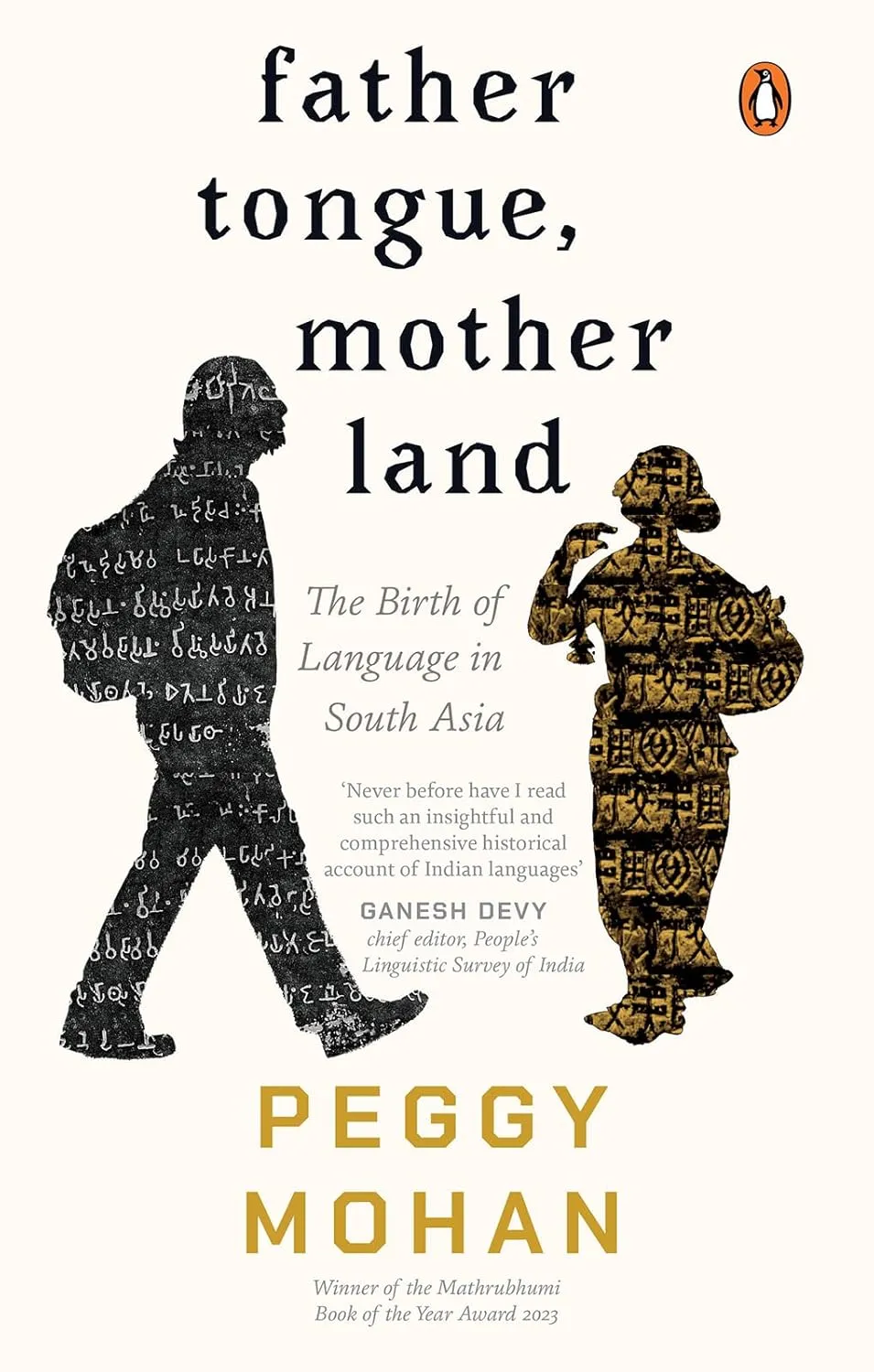
Father tongue, mother land: The Birth of Languages in South Asia is a natural successor to Wanders, Kings, Merchants, taking on perhaps the biggest puzzle in Indian language history: what did the people of the ancient Indus civilization's undeciphered script speak and write? Was it one language or many languages?
To answer these questions Mohan uses linguistic archaeology – tracing the features in spoken languages across age and place – to unravel their origins, almost always in a combination of languages, creoles as she puts it. She uses the model of "father tongue," where male entrants to an area, invaders, traders or migrants, mate with local women. Their offspring generally learn to use their father's vocabulary, often the politically or economically more dominant culture, pasted on grammatical structures more familiar to their mothers, who actually teach them to speak. This process produced what she terms "semi-stable contact varieties" that eventually solidified into distinct languages. Thus are hybrids born, and most Indian languages are hybrids, multi-generational mixtures of every sort that contain their history in words and peculiar grammatical structures.
Mohan makes a big deal of the ergative form, where the verb takes on the gender not of the subject but the verb itself, e.g. main nay dekha which is the same whether a male of female is saying it. Common to Punjabi, SIndhi, Pushto and other western Asian languages, it is not found in the same way in original central and southern Indian languages (ancient Munda or Dravidian). Mohan uses this to posit, as others have done before her, a so-called "Language X," that once flourished in the Indus basin. "Language X" is a hypothetical substrate language of the Indus Valley Civilization whose "ancient bones" she claims are visible in modern South Asian languages. It mixed, in her analysis, with proto-Dravidian (or helped to make what we call proto-Dravidian) and maybe even Munda languages that could have come together to form the common language of a ruling elite in the Indus civilization, perhaps in addition to what must have been the mixture of languages spoken in the wider region at the time.
According to Mohan, the closest language that might approximate an ancient Indus language is the Burushaski language of the Hunza valley in Pakistan's Northern Areas near the Chinese border, a long-puzzling, isolated language with multiple genders and other "archaic" features that have long befuddled linguists. It seems unrelated to all surrounding languages but Mohan finds similarities that brings it within the ambit of her analysis, but it may still be a leap. As Mohan shows languages have changed so much in the course of each thousand years, we don't yet know enough about Burushaski's origins to place it firmly in any family of languages. Still, it is an intriguing supposition.
Certainly the layered language blend model is well-articulated. Mohan's personal anecdotes, extrapolation and inferences drawn from other Indian historical interactions between old and new people and languages, the examples she also draws upon from world history and the Caribbean region in particular, resonated with this reader. As she defines it, "the main purpose of this book: which is to understand a particular type of language hybridization that we find again and again in the subcontinent, and how the different strands of lineage manifest in new languages that get made," (p. 194) is very valuable. Her examples make what can be abstract ideas real. Language acquisition, merging, blending and evolution is something we are all living and can relate to well, especially in a multi-language world like modern South Asia where people exist in a sea of languages. Why should the past have been any different?
While it hard to summarize her arguments, a wrap-up of sorts comes some 200 pages into the book and is worth quoting at length, also because it firmly rejects equating language and race, a common error in thinking about these things:
"Dravidian is not a useful term for referring to a population group, as all South Asians, barring the Andaman Islanders, are the result of a mixing of earlier and later migrant groups. It is only useful for identifying languages with Dravidian vocabulary, and when we say that people are 'Dravidian', we only mean that they are native speakers of one of these languages. But anyone can pick up any language: you do not need to be from a particular group to adopt its language. We need to get past these old racial labels. We are all the result of mixture.
"About 9000 years ago there was a migration of farmers from the Zagros mountains of southern Iran into Mehrgarh, in what is now Balochistan. These migrants, like all migrants, would have been mostly male. They came into contact with First Indians, hunter-gatherers settled all over South Asia and in the Indus Valley region too, and created mixed families as they settled down and had children with local women, and produced languages using the characteristic two-step process we have been observing since the start of this book. An early generation of children would have learnt their 'father tongue' well, but with a 'local accent', after which local people, not related to the migrants, would have adopted new words, slotting them into their old grammars. This is the same thing we saw in Chapter 5, where Indo-Aryan words slowly slipped into the Munda languages essentially without the old grammar changing.
"In time, this mixed population set up the Indus Valley Civilization, and theirs would have been a language (or, more likely, a language family) that drew most of its words from the languages of the migrant men, while nesting them into an operating system essentially preserved from earlier local languages. The Indus Valley is too vast a terrain for there to have been just one language, especially back in those times, when connectivity between different parts of the region would have been poor. If this scenario is accurate, it would mean that the languages that we now call 'Dravidian', when they first appeared in the Indus Valley, would have been our familiar Tiramisu bear hybrids, with a strong component of earlier local languages in all but their vocabulary. That would also account for why specifically 'Dravidian' languages are not to be found outside of South Asia. Later migrants into the Indus Valley area would have followed this pattern, creating more mixed families that included local wives and half-local children. As a result, features of the First Indian languages, like retroflexion, the most iconic sound contrast in South Asia, and many basic notions of grammar passed on into every new language that came up in the area. This common First Indian substratum explains why there is, to this day, a general sameness in the bedrock underpinning almost all our languages in South Asia," (p. 222-3).
Mohan's work tries to integrate genetic, archaeological, and linguistic evidence for prehistoric language change and evolution; the quote above is followed by a look at the 2019 genetics paper The formation of human populations in South and Central Asia that seems to support her overall arguments. Of course, there are a lot of gaps and the continuing silence of Indus signs mean that all bets are off. Unlike successful historical linguistic reconstructions that rely on documented intermediate stages, Mohan's theory requires substantial inferential leaps across millennia without written records.
Nonetheless, there Father tongue, mother land presents an exciting theory challenging traditional views of Indian language evolution. Her central argument, which revolves around the concept of "father tongues" - languages formed through male migration patterns where incoming men contributed vocabulary while local women preserved grammatical structures from their native languages, has been attested to before in history throughout the world, and it offers a new lens through which to inquire as to what language (s) likely flourished in ancient Indus times. It is a bold contribution towards thinking about this problem more richly and with the nuance that a single-language or language-family approach typically lacks.
- Omar Khan, September 2025