
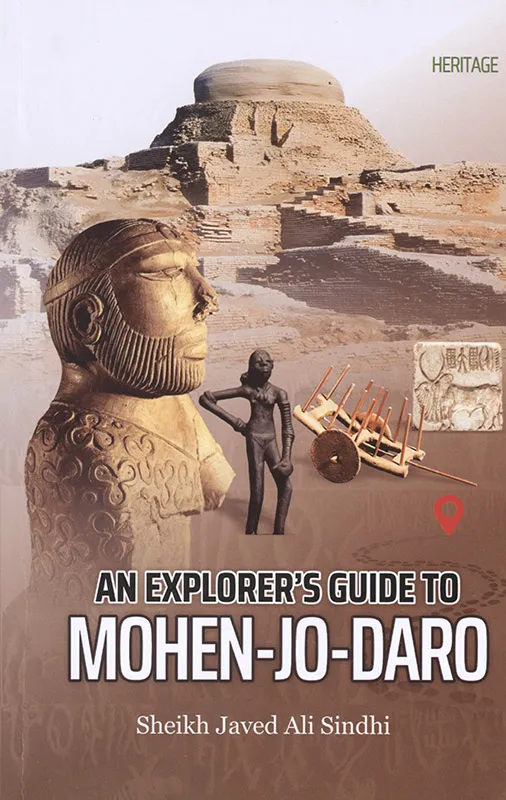
While visiting Mohenjo-daro in early 2025, I asked one of the best guides to this vast ancient city, Sheikh Javed Ali Sindhi, whether there was a booklet or guide available. He said no, but that he was working on one. Finally it is here, I can heartily recommend it as the first such book in a long time, an excellent companion both for visitors to the site and for kursi travelers around the world (full disclosure, I wrote the Introduction). Lavishly illustrated with archival photographs, maps and tables, it includes many primary sources of information such as by D.R. Bhandarkar, the first archaeologist to write about it when it was still largely hidden in the Bagi Forest in Dokri Taluka Larkana; R.D. Bannerji, the first and critical excavator; Sir John Marshall, the man who announced the discovery of the Indus civilization to the world and excavated here; E.J.H. Mackay, another major excavator; Sir Mortimer Wheeler and George F. Dales who carried out later excavations, and others. It is very helpful to see all these articles collected here into one volume and enhance one's appreciation of the site.
Sheikh Sindhi, who writes regularly the site and Sindhi history for The Friday Times in Lahore, comes from a neighbouring town, Shahdadkot. He has been fascinated by Mohenjo-daro since his school and college days, and has put together his own library of books and articles on it. He writes knowledgeably about the various mounds that comprise the larger area (even Mohenjo-daro airport, not to speak of the rest area and current museum were built in earlier times on what are most likely un-excavated parts of the site). He embodies the real pride that people in Larkana district and Sindh in general take in what is thus far the greatest known ancient Indus city, a diverse and extensive urban landscape that was possibly the most advanced Bronze Age cities in the world.
One of the best things about this guide is that it takes the visitor beyond the well-known, well-photographed stupa-mound area to the DK (Dikshit), VS (Vats), HR (Hargreaves), SD, L, Moneer and other areas of Mohenjo-daro excavated in the 1920s and 1930s, without which it is hard to grasp the range and complexity of urban life there more than four thousand years ago. It increasingly seems as if these areas where separated by walls from each other, like at Harappa, suggesting different settlement epochs or people who occupied different sectors at different times during the centuries. The site plan at the front of the book is nicely colored, and graphically reminds us of how little of the site has actually been excavated (less than 10% by some estimates). Questions are answered, and the viewpoints of many archaeologists from all over the subcontinent and wider world are included and discussed by Sindhi.
The 130 well-printed pages take us through to the most recent discoveries, including the copper coin hoard from the Kushan period discovered in 2023 and the new investigations of the city wall in 2025-26 that revealed Kot Diji period pottery that show that its construction dates back to 2800 BCE, far earlier than first thought. This is more evidence that the city was constructed over time, like Harappa, and not built all at once as a planned city as some archaeologists have argued. Given that the city wall is likely to have encompassed a large area, it indicates that something about the nature and importance of a city per se was present in very early Harappan times.
- Omar Khan, May 2026
The book is easily available in Pakistan from the author, but can possibly also be purchased abroad directly from him. He can be contacted directly at [email protected].