
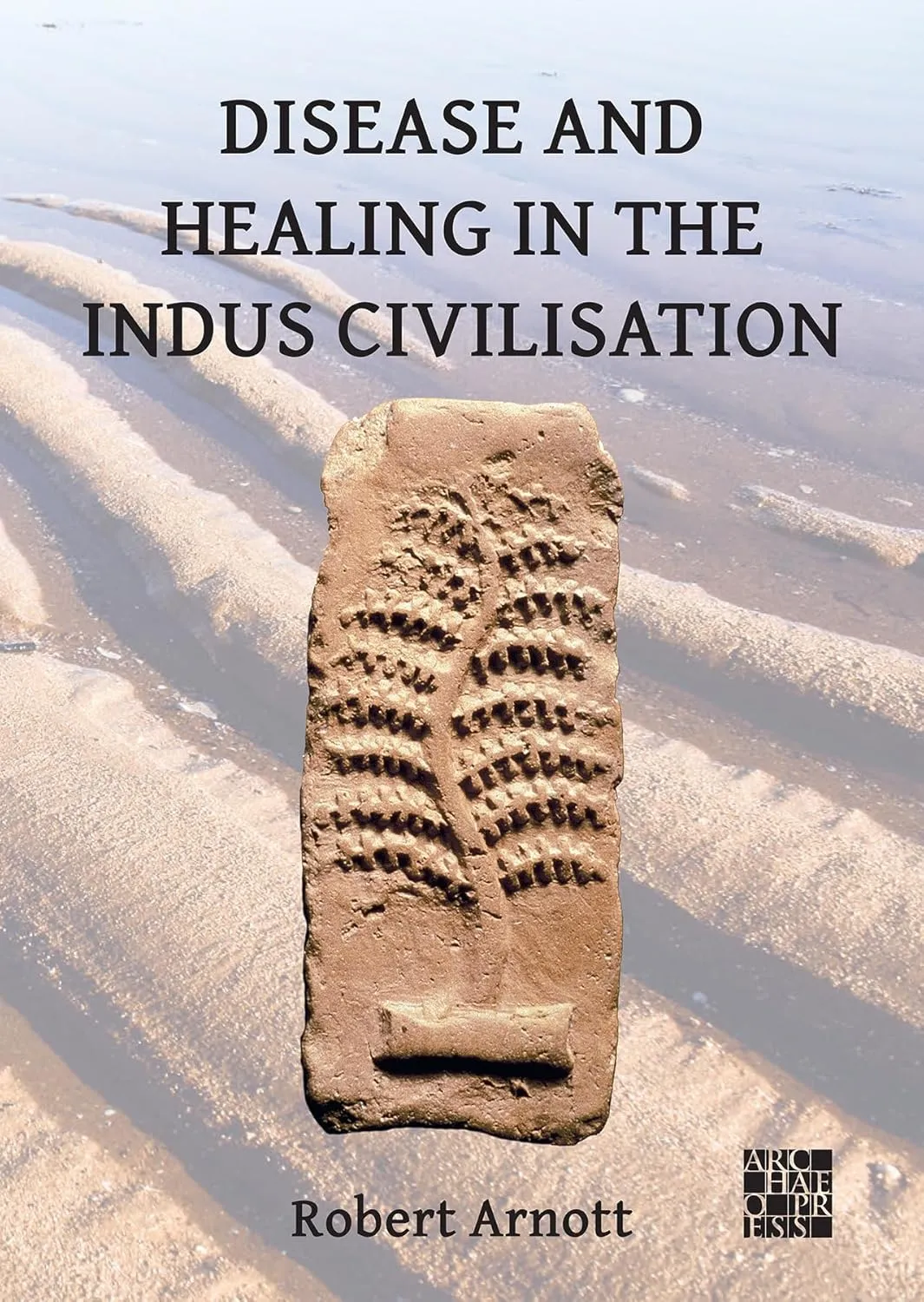
Disease and Healing in the Indus Civilisation is an absorbing book that brings to the reader in most direct fashion the complexities of living in some of the world's first cities. Dr. Robert Arnott manages to collate the manifold existential challenges inhabitants would have faced and brought them together for the first time in one place. The reader will come away with a much richer sense of everyday life in places like Mohenjo-daro and Harappa.
The novel challenges to human bodies living in large, varied, close-quartered and ever-changing groups of people in budding urban centers would have been enormous. Diseases could spread easily, there were few natural immunities to new vectors of infection. Crafts each had multiple risks for workers. The close proximity of animals made it easy for pathogens to jump species, as they still do, with possible cataclysmic results. Abundance created its own discontents – richer carbohydrate diets for example led to greater tooth decay in mature Harappan times. Dr. Arnold, well-versed in these issues to the west, in the Mediterranean region during the Bronze Age, brings a richness of analysis and discussion to this important contribution and summary of what is known and can be inferred about Indus diseases often lacking in scholars focussed on single civilizations.
Sadly, Dr. Arnold, who was at the University of Oxford, passed away in September 2024, a few months after this book appeared. Certainly this is a loss to measured, comparative analyses of important archaeological and historical issues that are often missed in the search for structures and material objects. The wonderful epigraph to the book, from Thomas Mann's The Magic Mountain (1924) indicates the breadth of his approach: "“All interest in disease and death is only another expression of interest in life.”
The first chapter is a concise summary of the ancient Indus period. Arnott seems to favor at least a weak form of the "peaceful realm" hypothesis even if examples that follow about physical and other trauma to skeletons undermines it; nonetheless he effectively lays the groundwork for the next chapter, focusing on its geographical extent, urban structure, and the complexity of its society. It provides an overview of the Pre-Harappan, Early Harappan, and Mature Harappan phases, emphasizing the indigenous development of urbanization and agriculture. He describes the all-important interactions between rural and urban populations. There is a particular focus on the evolution of urban centers like Mohenjo-Daro and Harappa and their role in long-distance trade with Mesopotamia and other regions.
The second chapter delves into the health and demographic aspects of the Indus Civilization. It examines life expectancy, nutrition, and the effects of urbanization on health. It also discusses the impacts of climate change, sedentary lives, and agricultural practices on the spread of diseases. The chapter highlights the health challenges faced by women and children and how these would have varied across different social strata - likely the majority of urban populations, then as now.
The third chapter surveys all the evidence of disease and we have found largely from skeletal remains at both Harappa and Mohenjo-daro, and evidence of diseases known to be prevalent at the time. There is a lot to go over here. He uses the work of others, like Nancy Lovell and Gwen Robins Schug, to draw a dynamic picture of the many threats residents faced. It covers infections like tuberculosis and leprosy, zoonotic (cross-species) diseases, and other health issues related to agriculture and urbanization and correlations with these two forces. The chapter also addresses trauma caused by injuries, violence, or accidents, as well as degenerative diseases such as osteoarthritis and dental pathologies. The chapter offers insights into the health conditions faced by various segments of society, and dental health as a reflection of diet and overall health.
One of them is very much with us today. "Of all the diseases that would have affected the Indus Civilisation and their predecessors, one of the most serious would have been malaria, often credited with providing major social and environmental consequences on any society in which it is prevalent," writes Arnott, and he further defines it in a way characteristic of his multi-facted approach as "an active and dynamic biological cyclical entanglement of three species and two fluids" (p. 71). After describing the factors that lead to the prevalence of this 30 million year-old disease he writes of something often hard to keep in mind when thinking about the material remains of a society: "The evidence suggests that the Indus region in prehistory would have met each one of these four conditions, providing an ideal environment for the prevalence and virulence of malaria. Not only harmful to individuals, malaria can also strike whole communities in an epidemic form, as do many other acute diseases, but it is usually as a stable and endemic disease which affects communities by its slow and insidious erosion and undermining of their energy and fecundity," (p. 72).
The fourth chapter, Diseases of Occupation, may be the most interesting. For all we marvel at Indus craftsmanship, each of these practices had its own hazards for workers, whether anthrax from wool-working – "also known in England historically as ‘wool-sorters’ disease’" (p. 102) – to joint and other stresses from weaving, chemical residues overwhelming tanning workers, or eye-strain affecting seal carvers who worked tiny surfaces without the benefit of glasses. This is not even to speak of what would have been hundreds upon hundreds of sewer-cleaners in a city like Mohenjo-daro! Each of these is discussed in detail, opening a whole new vista of understanding on the challenges Indus workers would have had to deal with without benefit of later tools, medications and practices that minimized damage to those involved.
The fifth chapter on public health and sanitation discusses the advanced public health infrastructure in the Indus cities, including water supply systems, urban drainage, and sewage disposal. It is a welcome reminder of just how innovative and impressive Mohenjo-daro's water-provisioning and drainage system was, while not ignoring the human cost of keeping it as clean and free of odor as possible. Even so he can't help marveling at Indus accomplishments – here is his description of the Great Bath: "The basin was supplied with water from a double-walled cylindrical well in one of the compartments bounding the pillared gallery on the east. This does not necessarily imply that the basin, with its capacity of 150 m3 of water, was filled by hand, especially since they were such experienced hydraulic engineers; however, no traces of a filling mechanism has yet been detected. A drain outlet in the south-west corner of the basin allowed the used water to flow out into a larger brick drainpipe, c. 1.8 m high, which was large enough to walk through for purposes of cleaning and maintenance and was roofed by a corbelled vault. The extraordinary height of this drain tunnel may have been necessitated by the difference in level between the floor of the basin and the surface of the public street outside. After running northwards for c. 8 m the drain shifts to the north-west, cutting across the north-eastern corner of the lower section of the so-called granary. After another 40 m, it turns north again to bypass older buildings. The construction of the actual basin testifies to the high standard of Indus Civilisation engineering," (p. 127). By now the reader is aware that this level of construction would have had a lot of human costs as well – bricks did not come for free.
Chapter six, while shorter, focusses on how to help heal and treat the people under so much strain. It examines the healing practices and medical knowledge of the Indus Civilization, the religious and magico-ritual aspects of healing, the use of plant and mineral remedies, and the evidence of surgical practices, including cranial trepanation. It highlights the use of various possible medical instruments and the role of healers in society. Important but unanswered questions about the intersection of healing, religion, and medicine in the Indus Civilization arise.
Trees may have been critical here. For example, Arnott asks "What is the significance of the enclosed acacia and pipal trees? The pipal tree can be found in other likely religious contexts. Three seals, possibly amulets, from Harappa show the pipal tree forming an arch over a standing figure,16 and an intaglio from Mohenjo-daro shows a horned figure standing between the branches. In other seals from both Harappa and Mohenjo-daro there are scenes of a similarly horned figure standing between two pipal branches or trees. These representations suggest that the pipal tree possessed a horned ‘spirit’ or ‘soul,'" and, continuing, that "the roles of the neem and pipal trees seem to have been central to Indus Civilisation medicine. As well as the iconography, also found in deposits at the site of Kunal were remains neem tree leaves, which have proven versatile healing properties, particularly with dermatological complaints (skin infections and wounds), fevers caused by malaria, internal parasites, and gastroenterological and liver disease. Every part of the tree has a medicinal use – leaves, leaf extract, bark, gum, young shoots, blossom, fruit, seeds and seed oil, which are applied in combination with other medicines," (p. 137).
The final chapter brings together the key findings of the book, emphasizing the complexity and advancements of the Indus Civilization in health, disease, and healing practices and reflects on the limitations of the available evidence and the future potential of research into the health and medical practices of this ancient civilization. The entire book makes clear the significance of interdisciplinary approaches in studying the health of ancient civilizations, even as challenges remain in interpreting health and disease from skeletal remains and archaeological evidence. Clearly deciphering the Indus script would give us much more insight into these issues, but in the mean time Robert Arnott has done a very fine job in bringing together all that we know today. It is most unfortunate that he is not able to pursue the questions he raises anymore.