
How can cuneiform – the ancient writing system used in Mesopotamia during the height of the Indus civilization – help us better understand the Indus writing system?
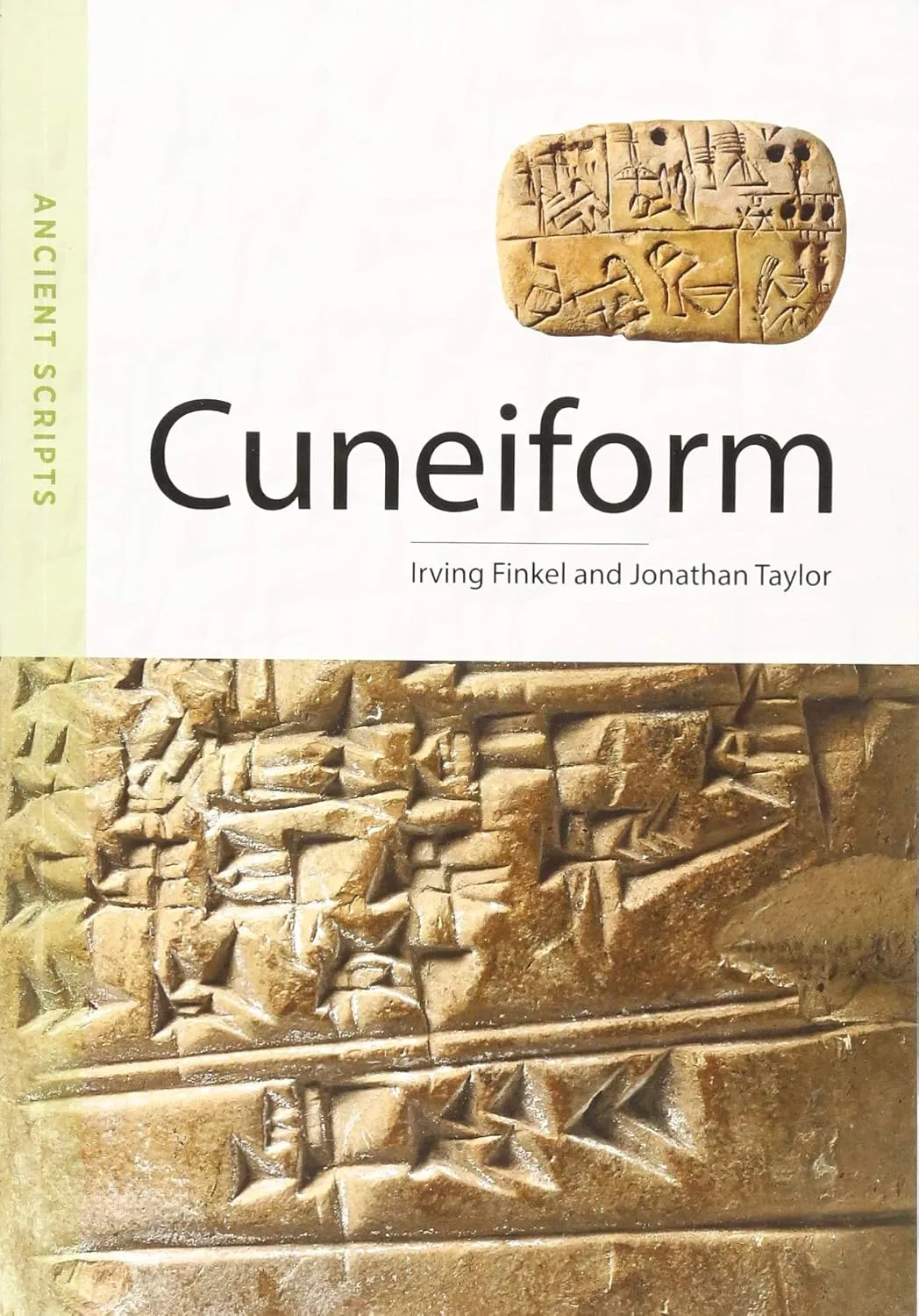
Cuneiform, a wonderful little book by Irving Finkel and Jonathan Taylor, Curators of the British Museum's enormous such collection, is a great source of information that might help us consider the issue of similarities and differences more carefully. Both systems seem to have flourished around the very same time (2500-2000 BCE) and were in conversation with each other. We know trade between the two civilizations was important. The origins of writing and trade are inextricably linked. In particular, because we have deciphered much of cuneiform and know a lot more about its use, it allows us to ask relevant and explore significant differences which seem to emerge in the archaeological records between the two systems.
The book is also an engaging, accessible introduction to the world’s oldest known writing system. It brings to life the people who wrote, read, and learned cuneiform, with anecdotes, illustrations of tablets ranging from school exercises to royal literature, and insights into the everyday concerns and grand epics the script recorded. One of the book’s major strengths is its ability to humanize ancient scribes and societies, making cuneiform’s world relatable to a modern audience. There are all sorts of clues in their exposition of cuneiform that helps us imagine relevant scenarios and questions tha pertain to the ancient Indus writing eco-system.
"Cuneiform is a kind of writing, not a language" write the authors. "The word cuneiform comes from Latin cuneus 'wedge', and simply means 'wedge shaped'. The word refers to the shape made each time a scribe put stylus to clay. The cuneiform writing system is also not an alphabet, and it doesn't have 'letters'. Instead it used between 600 and 1000 characters to write words (or parts of them) or syllables (or parts of them). It's like writing '&' instead of 'a n d' or 'ca-at' instead of 'cat'. The two main languages written in cuneiform are Sumerian and Akkadian (from ancient Iraq), although over a dozen others are recorded, most important among them Hittite," (p. 6). Archaic cuneiform developed around between 3200-2900 BCE (around the time the first Ravi Phase inscribed sherd from Harappa dates from), apparently in the city of Uruk, as a bookkeeping tool. This, the authors write is when "prehistory stopped; history began," (p. 7). A later myth claimed that Enmerkar, king of Uruk, invented it to help send messages during battle, but the record-keeping origin seems the more certain.
Cuneiform is characterized by wedge-shaped incisions on clay which became sharper and more stylized over time (see book cover above); the orientation of the writing also changed at one point. It took centuries before it was used for lengthier inscriptions as well, but then endured for some 3,000 years – whereas the Indus script seems to have vanished with the civilization around 1900 BCE. One of cuneiform's strengths was its adaptation to different languages. As the primary language in the region shifted from Sumerian to Akkadian, scribes created tablets that helped interpret older Sumerian inscriptions into Akkadian ones, a translation regime that helps us understand the script better today. Cuneiform script was used for many languages, and mastering it was a demanding skill even in antiquity. Cuneiform was later also used for Assyrian and Babylonian, up to at least the 6th century BCE, a three-thousand year utilization history that is breathtaking to behold, way longer than any communications protocol in recent history.
Among the interesting things that emerge as the authors delve into cuneiform, is that one of its uses was to stamp bricks with sometime like a larger version of an Indus stamp seal which inscribed into the bricks the name of the ruler, titles and/or dedications that literally were embedded in the building. This tradition continued for two thousand years and is of great help to archaeologists. Despite the fact that Indus cities are composed of fine, uniform bricks, no such inscriptions are found on them. Why? What might this suggest about social organization?
Learning how to write cuneiform was no simple task, and required schools and practice tablets. We have much evidence of grueling training. Scribes tended to come from families. One might presume this would have been the same for Indus seal carvers, tablet makers and writers on perishable materials. There were also libraries and large collections of tens of thousands of cuneiform tablets, even catalogues of these collections (colophons). We have found no such thing thus far in ancient Indus cities.
How literate was the general population? Whereas some 600-1000 characters were used to write words or parts of words, a much smaller number, say 200, were could be used to write a legal statement (p. 35). So some sort of literacy could have been more widespread than full literacy. When one considers the Dholavira signboard found on a gateway to this Indus city, perhaps the same could be said about Indus city dwellers, something Shereen Ratnagar speculates could have been the case in Mohenjo-daro as well. The many seals found in the DK-G area of the city suggests that this area might have been quite literate.
Decipherment of cuneiform was a big struggle, and benefitted from bi-linguals, and the fact that scribes liked to harken back to older Sumerian inscriptions even as they wrote in Akkadian. Still, the meaning of different signs and the words they designated varies with context, so that it is not a simple matter of inscriptions having singular meanings. "Gradually what we now take for granted came to appreciated [by decipherers]; any given cuneiform sign could have more than one sound value and more than one meaning, and a given sound could be expressed by more than one sign. This aspect of the nature of cuneiform signs was unsuspected until the pioneers discovered duplicates of one and the same texts in which identical words were spelled differently," (p. 43). It is quite possible that ancient Indus signs functioned similarly, and could designate products, names, gods, or places depending on what kind of object they appeared on and together with which other signs or even creatures. There is a huge amount we don't know, but what the story of cuneiform suggests is that ancient people were far more sophisticated and could deal with a lot more complexity than we might think. After all, they were the greatest innovators.
Women were apparently a minority among scribes, but they did write, and the world's first known named poet, Enheduanna (c. 2285-2250 BCE) of Ur, was female. Many surviving letters were to and from women, showing that they fully participated in in literary society, which might have been quite possible in Dholavira or Harappa as well. Could they have played a much bigger role relatively speaking in ancient Indus-period societies than in later South Asian history?
This book is a highly relevant if oblique way to take on some of the most cogent aspects of ancient Indus writing, with Finkel and Taylor's masterful decoding of the parallel world of cuneiform.