Home

Main navigation

  • home
  • slides
  • essays
  • articles
  • books
  • video
  • q & a
  • blog
Secondary menu
  • about us
    • scholars
    • privacy
    • support
    • image rights
    • credits
    • contact us
  • resources

Walls

Ancient Indus walls.

Mound AB, Harappa

  • Mound AB, Harappa

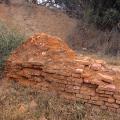
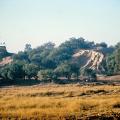
The high mound at Harappa (Mound AB) is surrounded by a massive mud brick city wall with large square ramparts. One of these eroding ramparts is visible through the underbrush that now covers the site. The flags mark the tomb of a Muslim saint that … >

Hollow baked brick buttresses

  • Hollow baked brick buttresses

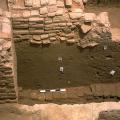
Hollow baked brick buttresses were later built up against the original "granary" structure on top of a shallow mud-brick platform [400] that itself overlies the mud-brick platform of the original "granary". Below these platforms is baked brick wall … >

Harappa phase ashy debris deposits

  • Harappa phase ashy debris deposits

Ashy debris deposits continued to accumulate outside of the perimeter wall, covering the curtain wall. These date to the end of Harappa Period 3B and the beginning of Period 3C. The area continued to be devoid of structures, although what later rema… >

Unexcavated Mounds at Harappa

  • Unexcavated Mounds at Harappa

The mounds at Harappa remain largely unexcavated. Approximately half a percentage of the site's area was unearthed each season by the Harappa Archaeological Research Project (HARP) in the 1990s. >

Harappa Walls

  • Harappa Walls

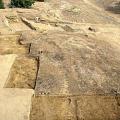
A view of a part of the area of Parallel walls, Mound F, possibly before deep digging. One thinner wall is exposed, and traces of the others visible. NOTE: Photos Block of Parallel Walls, Block of Parallel Walls and Harappa Walls are of the area … >

Eastern edge of Mound E

  • Eastern edge of Mound E

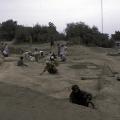
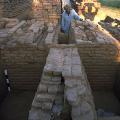
Clearing the ancient Harappan debris from the eroded surface outside of the mud brick city wall at the eastern edge of Mound E. In 1997 this area of Trench 11 was cleared to define the stratigraphic sequence between Period 3B and 3C. It was possible… >

Excavations conducted in narrow space

  • Excavations conducted in narrow space

Excavations were conducted in the narrow space running west from the buttresses and between the interior walls to determine what was inside of the "granary" structure. >

Cross-section through debris deposits

  • Cross-section through debris deposits

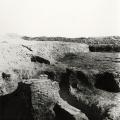
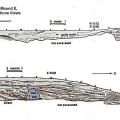
Cross-sections inside (top) and outside (bottom) of perimeter wall [250]. The wall itself, being of mud-brick, was heavily eroded, sometimes to a lower elevation than the adjoining more densely packed street debris. As can be seen in the bottom cros… >

Western edge of REM Granary excavations, Mohenjo-daro [46 A]

  • Western edge of REM Granary excavations, Mohenjo-daro

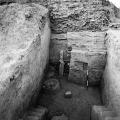
ACC - Citadel Gateway Southeast Southeast corner of ACC Gateway excavation showing the corner of the later "city wall" and underneath are earlier wall fragments including what looks like small earlier structures. The presence of large jars set in… >

Massive Brick Walls at Mohenjo-daro

  • Massive Brick Walls at Mohenjo-daro

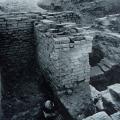
SHOWING A POT (IN FOREGROUND) THAT CONTAINED EARLY INDIAN OBLONG “PUNCH-MARKED" COINS (KARSHAPANAS): MASSIVE BRICK WALLS OF THE SECOND AND THIRD PERIOD AT MOHENJO-DARO >

Pagination

  • First page
  • Previous page
  • Page 1
  • Page 2
  • Page 3
  • Page 4
  • Page 5
  • Page 6
  • Page 7
  • Next page
  • Last page
Large unicorn seal
© Harappa.com 1995-2026 31