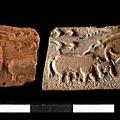
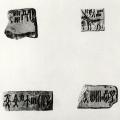
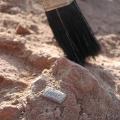
Although neither of these specific molded terracotta tablet pieces comes from Trench 11, four less well preserved examples from the same mold(s) were found in debris outside of the perimeter wall in that area, clearly establishing a second half … >
Molded tablets from Trench 11 sometimes have impressions on one, two, three or four sides. This group of molded tablets shows the complete set of motifs. One side is comprised entirely of script and has six characters, the first of which (on the ver… >
These steatite seals are depicted in Sahni's report for 1923-24, although only only is described and its location provided. The four seals are listed clockwise from the top left. Seal 1: (Sahni Pl XIX, 13)Seal 2: M…>
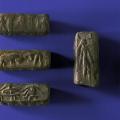
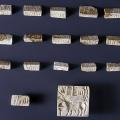
Sixteen three sided tablets (c. 2300 BCE) with incised inscription on each face were found all together in the debris that had been dumped over the curtain wall (54). On one of the three sides is an inscription that is identical to the last two sign… >
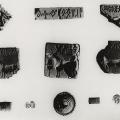
Published in ARASI 1924-25, Plate XXVIII. Title of plate: ‘Seals and Other Objects’ Four unicorn seals, a rhomboidal seal, and rectangular seals. The provenance for some provided in the object label quoted below. From left to rig… >
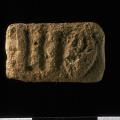
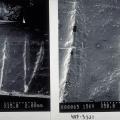
Scanning Electron Microscope analysis of the incising marks on the steatite tablets indicates the use of three different specialized bronze graving tools (see 58). Each tablet was first shaped from raw unfired steatite and then incised with the scr… >