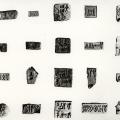
Seven unicorn seals, all but two broken, among other types. Top row Left: Published in ARASI 1924-25 Plate XXVII, No. 8, “A (b) 922” Third from Left: Published in ARASI 1924-25 Plate XXVII, No. 4, “A (i) 16” Fourth from Left:… >
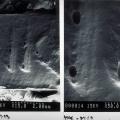
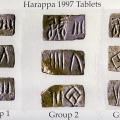
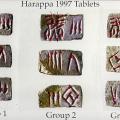
For the second group of tablets the leading edge of the incision is more rounded and there are grooves along the wide slope of the cutting angle. The third type of tool is equally distinct. When combined with tablets found in earlier years there are… >
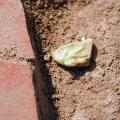
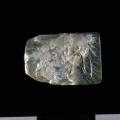
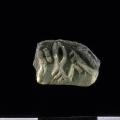
Faience tablet fragment (H2001-5064/2373-01) with glaze still quite well preserved. The bright greenish blue glaze is usually not preserved on artifacts that have eroded from the Trench 54 South workshop. >
Three groups of tablets can be defined on the basis of the type of tool used to incise them and the style of inscribing. The most complex script sign appears to have been made with different numbers of strokes for each of the three groups. This sign… >
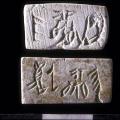
These two inscribed tablets (c. 2300 BCE) have the same inscription, but it was written in opposite directions. What is even more interesting is that the top tablet is incised with the same "handwriting" as the Group 2 tablets described in (59). The… >
This uniquely shaped tablet (H2001-5090/2913-09), also made with two colors of faience, has an inscription similar to that seen on the previous slide (67). This tablet was found inside the workshop in Trench 54 South. >