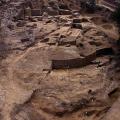
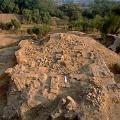
The northern end of Mound AB, shown here from the North, comprises more than 17 meters of occupational debris beginning on top of an old levee of the river Ravi and continuing up from the Ravi [Aspect of the Hakra] phase (Period 1 from before 3300 t… >
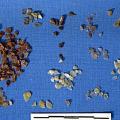
After wet screening, the Ravi phase microdebitage, larger flakes, broken drills, and even microbeads are sorted according to type of artifact and kind and color of stone. >
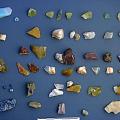
During the Kot Diji phase many new types of raw material were brought to Harappa for making ornaments and tools, indicating expanded trade networks and suggesting a growing population of consumers. A wide variety of stones reflecting different s… >
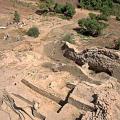
Top of the northern end of Harappa Mound AB. Brick robbing has removed all of the large walls of substantial Harappa phase buildings, leaving the massive void visible on the right. Smaller divider walls and thresholds were often overlooked, allo… >
A portion of a large brick drain (Feature 8) was discovered beneath the Harappan wall (see Image 63). This drain runs E-W and would probably have emptied into a larger N-S drain that flowed to the North through a now-missing gateway. >
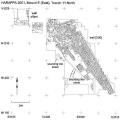
Plan view of the portion of perimeter wall [250] excavated in 2001. The pattern of the bricks suggests a complicated series of additions to the inside of the structure that are not yet well understood. There may have been a gateway at the northweste… >
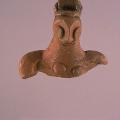
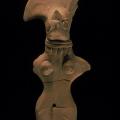
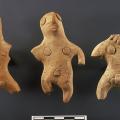
At the peak of the Indus Civilization or the Harappan Period (Period 3), the most common dress for female figurines was the belt and/or short skirt usually situated at the same point on the hips as the figurine’s hands. The fan-shaped headdress was … >
Male figurines may be distinguished by genitalia and/or small flat nipples. A few male figurines wear chokers with pendants very similar to those worn by females. Some males are depicted with bowed legs. Approximate dimensions (W x H x D) of the … >
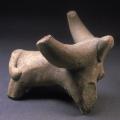
Some quadruped figurines are difficult to classify because the general form and many of the attributes of humpless cattle, water buffalo, and even rams may be very similar. Any of the three may have incising on the face and/or horns. Sometimes the s… >