Home

Main navigation

  • home
  • slides
  • essays
  • articles
  • books
  • video
  • q & a
  • blog
Secondary menu
  • about us
    • scholars
    • privacy
    • support
    • image rights
    • credits
    • contact us
  • resources

Harappa

Harappa, Punjab ancient Indus civilization excavations, figurines, seals and other objects.

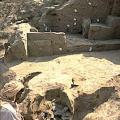
Excavations at the corner of the "granary" area

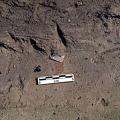
Excavations in 1997 at the southeast corner of the "granary" area were undertaken to recover a full sequence of pottery, architectural features, and inscribed objects. Here workers have found a seal near the base of the excavations in Trench 41NE th… >

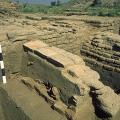
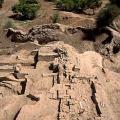
Excavation of one buttress

Excavation of one buttress [99] shows how the silt and garbage from the street spilled into the hollow area from the outside of the "granary", eventually blocking it entirely. >

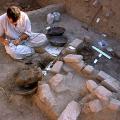
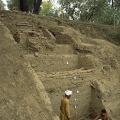
William Belcher removing charcoal

William Belcher has just removed charcoal for archaeobotanical analysis and radiocarbon dating from one of the hearths (image 35) and is making out a label for the sample. >

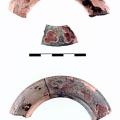
Terracotta bangle fragments

  • Harappa Terracotta bangle fragments

Terracotta bangle fragments decorated with red trefoils outlined in white on a green ground from late Period 3C deposits in Trench 43. This image shows both sides of the two fragments (H98-3516/8667-01 & H98-3517/8679-01). >

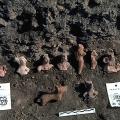
Collection of human and animal figurines

Collection of human and animal figurines from a large refuse dump in a pit in Trench 43. >

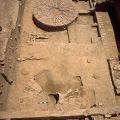
Detail view of the HARP-excavated platform

Detail view of the HARP-excavated platform in Trench 43 with Wheeler's platform to the east (toward the top of the image). Note the mud-brick wall foundations that surround each platform to the east, south, and west (the north walls remain unexposed… >

Ravi phase microbeads

Ravi phase microbeads of lapis lazuli (top row), amazonite, and carnelian (bottom row) indicate the size and nature of the drills used for perforation. The largest of the illustrated beads is less than one centimeter in diameter. >

Larger Kot Diji phase kiln

The larger Kot Diji phase kiln, here shown under excavation, had a highly vitrified and reduced interior. >

Kot Diji phase steatite seal in situ

Along the eastern edge of the Kot Diji phase street on Mound AB at Harappa, a broken unfinished steatite seal was discovered in 2000 (close-up in 46 and 47). >

Harappa phase structural remains

Overview of the north-south oriented brick wall (Feature 50) and doorway of the large Harappan building in Trench 39N. Note the earlier drain that runs east-west underneath the wall. >

Pagination

  • First page
  • Previous page
  • …
  • Page 59
  • Page 60
  • Page 61
  • Page 62
  • Page 63
  • Page 64
  • Page 65
  • Page 66
  • Page 67
  • …
  • Next page
  • Last page
© Harappa.com 1995-2026 31