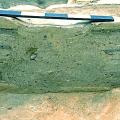
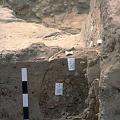
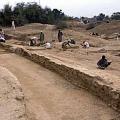
The cross section of the Ravi phase pit shows multiple episodes of filling and plastering. The contents were collected for flotation, which recovered seeds of barley and wheat as well as some charred wood. >
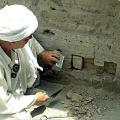
Blocks of soil removed from the Ravi phase section were taken to the University of Wisconsin, where they were impregnated with resin and sliced thin for microscopic analysis of cross sections of the bead-making strata. >
Careful excavation of the contents of the Kot Diji phase storage jar revealed a treasure of garbage that can tell us about the food the Kot Dijian people ate and discarded. >
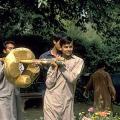
Laboratory assistants Mohammad Naim, Shokat Ali, Said Ahmed, and Mukthar Massih carry the cleaned and conserved ringstone to the Harappa Museum for display. >
Workmen are cleaning the Trench 11 area in preparation for photography during the 1997 excavation season. Perimeter wall [250] is on the left. The curtain wall in the center was constructed to retain trash that was thrown over the perimeter wall int… >
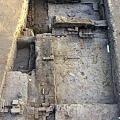
Structures in this part of Harappa were sometimes made of a combination of mud-bricks and baked bricks, sometimes mixed in the same wall as seen here in the case of both the southern part of the western wall and part of the northernmost wall. Walls … >
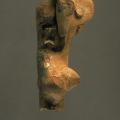
In addition to headdresses and hair decorations, loose hair is sometimes depicted on figurines. A few figurines have painted black hair extending from the back of the head to below the shoulders. Approximate dimensions (W x H x D): 3.9 x 5.2 x 2… >
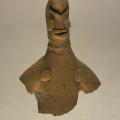
In addition to different postures, male figurines also exhibit a variety of hairstyles. Both male and female figurines may have hair swept around the top of the head, to the side or to the front. A few male figurines also wear a sort of "torque" cho… >
Although it was surely a wild animal, some of the rhinoceros figurines wear collars. While a collar might indicate domestication, it is unlikely that this is the case with the rhinoceros, although they may have been held as captives. Approximate … >
Several types of birds are represented in figurines. Bird figurines with long tapered tails probably represent parakeets. These birds often have flattened stylized feet that were attached to other terracotta objects such as cages of which there are … >