Slides on the archaeology and excavation of ancient Indus Valley sites including Harappa by Jonathan Mark Kenoyer of the University of Wisconsin, Madison.
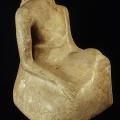
Seated male figure with head missing (45,46). On the back of the figure, the hair style can be partially reconstructed by a wide swath of hair and a braided lock of hair or ribbon hanging along the right side of the back. A cloak is draped over t… >
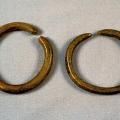
Two copper/bronze bangles, one from Harappa and the other from Mohenjo-daro. The bangles were made from a round hammered rod bent in a full circle. The space between the ends of the bangle would be pried apart to slip it over the wrist. Dimension… >
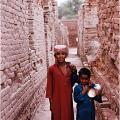
These two local boys decided to hang out in the ancient city after delivering a pot of milk to their father who is one of the site watchmen. The distinctive decorated hat worn by the older boy is worn throughout Sindh province in Pakistan. >
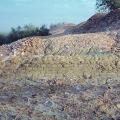
The foundations of many houses were constructed on top of massive mud brick platforms such as this one eroding from the edge of the mound along the major east-west street dividing HR and VS areas. The size of large mud bricks used for the constructi… >
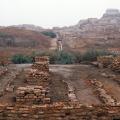
Close-up view of the pillared hall, which may have been a hall of assembly with paved walkways and places for people to sit in ordered rows along each aisle between massive brick pillars. >
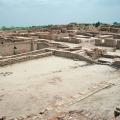
A small room located at the edge of the street (in the center of the photograph) is where fourteen skeletons of so-called massacre victims were discovered. >
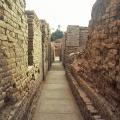
The doors of later buildings can be seen in the upper levels of the wall to the left. The gradual tapering of the walls in the far right was an intentional architectural feature to avoid collapse of the upper floors. >
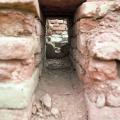
Close-up view of ground floor drain outlet from the street side, showing a brick on edge with a notch was placed across the drain hole to keep objects from flowing out with the bath water. >