
Indus @ the NMP Karachi
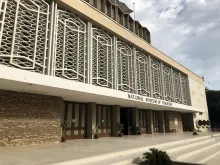
I made a visit to the National Gallery of Pakistan in Karachi – one of the finest ancient Indus collections in the world – in February 2024, five years after my last visit. Once again I took out my iPhone, as I have done at the Met in NY, MoFa in Boston, The British Museum, the Guimet in Paris and elsewhere.
Can one presume to say that the iPhone of today is as versatile as the hand axe was in the Indus of yesterday? The fruits of its visit to the main Indus gallery are in the slideshow below. Dusty dioramas reach back decades in the galleries, untouched by recent research. But the pieces themselves are indicative of expressive, deeply skilled Indus culture(s), a cornucopia of Mohenjo-daroan delights.
A mobile camera, the only recording device allowed with little opposition in museums today, opens new opportunities for sharing these objects: pieces in the context of other pieces, at weird angles, trying to look at things a little differently than regular archaeological photography. Not to mention finding objects here in Karachi that are barely if at all illustrated elsewhere. A number of objects these objects, we know not to what purpose they existed. Things have also moved around, been taken down or re-appeared since 2019 (the original "priest-king" is still not displayed, replaced by a replica).
This 37 slide show at launch (additions to come) attempts to show the objects in an order liberated from the display cases and standard categories. Images are mostly described in words from Ancient Cities of the Indus Valley Civilization by Dr. Jonathan Mark Kenoyer, as well as quotes from Sir John Marshall, Ernest J.H. Mackay, Dr. Asko Parpola and others.
Nothing is simple when it comes to Indus objects, and there is much room for speculation about these random pieces of a city 4,000 years ago.
- Omar Khan, March 2024
|
1. National Museum of Pakistan The National Museum of Pakistan was established in 1949 and shifted to his building in Burns Garden in 1970. |
|
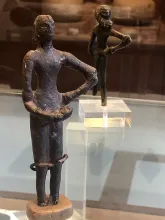
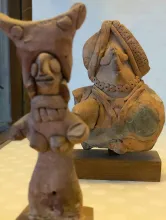
2. The Other Dancing Girl The female figurine, shown here with a replica in the background of the well-known "dancing girl" of Mohenjo-daro (that original is at the National Museum of India in New Delhi), may or may not be a dancing girl. |
|
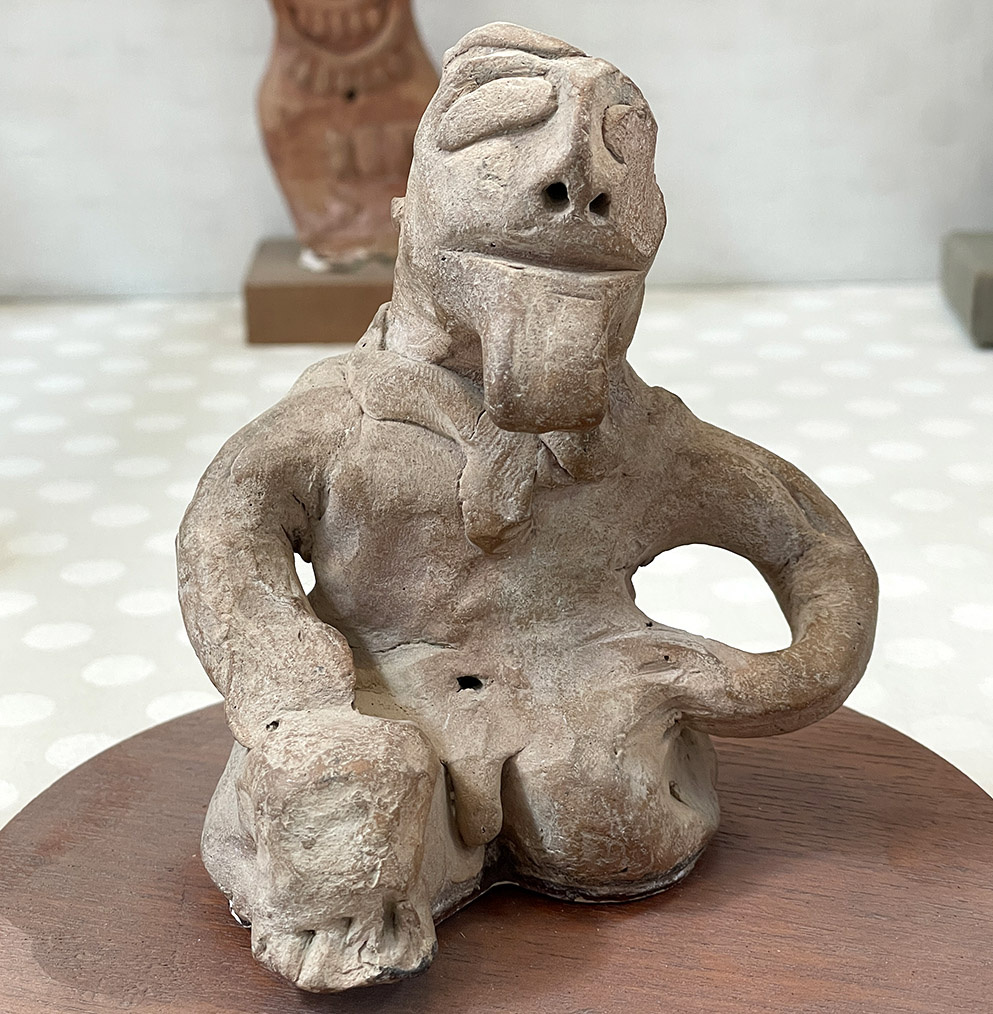
3. Male Terracotta Figurine Few Indus figurines exude so much character making it seem like it was based on a real person. |
|
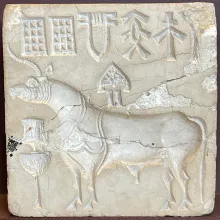
4. Unicorn Seal An incredibly well-preserved seal. The second image [above] is the sealing made from this seal, as shown in Shah, S. G. M. and A. Parpola, Corpus of Indus Seals and Inscriptions. 2. Collections in… |
|
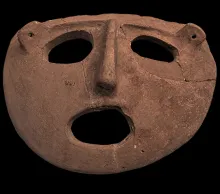
5. Mask with Open Mouth An evocative mask in which the holes referenced by Dr. Kenoyer can clearly be seen: "Mask with open mouth has holes for wooden teeth." |
|
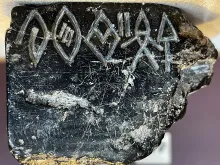
6. An Unfinished Unfired Seal One of the most intriguing of Indus inscriptions, displayed upside down in the glass case in the second image [above]. Was it going to be a seal or not? It looks like it. Dr. Kenoyer points out that … |
|
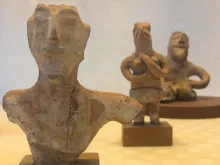
7. Male Figurine or Diety "Male figurine or deity with goatlike beard wears a horned headdress that is broken. Almond-shaped eyes and serene mouth are distinctive of the molded masks of a similar horned, bearded deity (cat… |
|
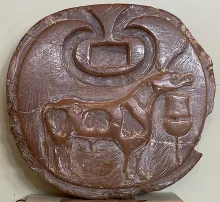
8. Harappan Pendant Among the most unique of ancient Indus objects, it inspired Dr. Kenoyer to surmise that "perhaps the most intriguing aspects of the ancient Indus culture are the religion and politics, which appear to have been closely intertwined." |
|
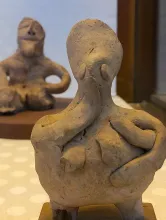
9. Female Figurine "Many female figurines have an infant in the left arm but this figurine has a mishapen piece of clay that is not very distinct," writes Dr. Kenoyer. Of a similar figurine found at Nausharo and dated… |
|
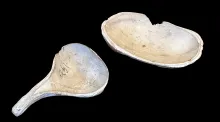
10. Two Shell Ladles Examples of one of the finest and most distinct of Indus craft objects. |
|
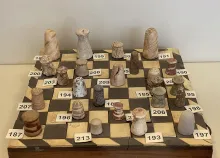
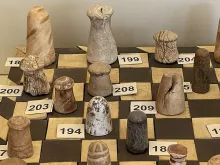
11. Game Board A wide variety of game pieces from Mohenjo-daro on a modern wooden board. Sir John Marshall, one of the earliest excavators at Mohenjo-daro writes in the monumental work summarizing the first finds… |
|
12. Indus Game Board Sir John Marshall continues describing the game pieces found at Mohenjo-daro (Mohenjo-daro, pp. 557-59): "The poorer people used gamesmen made of pieces of potsherd roughly rubbed into a suitable… |
|
13. Female Figurines with Turbanlike headresses "Figurines with elaborate headdresses and numerous layers of necklaces are usually somewhat larger than the more simple terracotta figurines." |
|
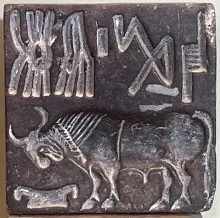
14. Short-horned Bull or Bison Seal The strict geometry and subtle deviations on this seal speak to how nuanced ancient Indus languages might have been (another view of this bison seal). The second image shows some of the sealings… |
|
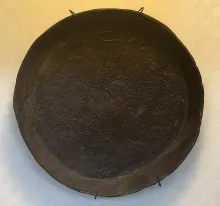
15. Metal Plate A copper/bronze plate with vertical sides that could easily fit into a modern household. |
|
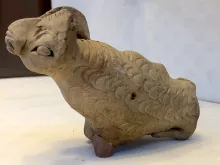
16. Ram Figurine Dr. Kenoyer writes (Ancient Cities, p. 164) referring to this ram figurine that domestic goats were "kept in cities, where they were used for meat and diary products, as well as for wool or goat's… |
|
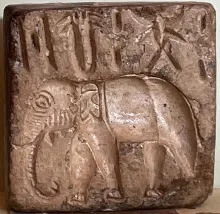
17. Elephant Seal Dr. Kenoyer writes (Ancient Cities, p. 84): "The elephant is also an important symbol of power that in later historical periods came to be associated with royalty, wealth and the deity Ganesha, the… |
|
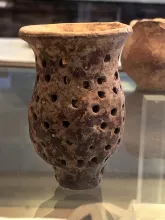
18. Perforated Jar A beautifully formed and now aged perforated jar. |
|
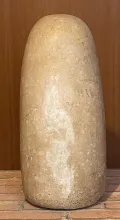
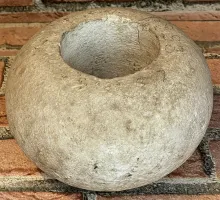
19. Linga? Sir John Marshall has an extensive section (see Images 2 and 3 for his references) on linga, yoni and the often difficult job of distinguishing them from game pieces and stones in general (Mohenjo… |
|
20. Ringstones While it may be surmised that these two circular stones are well-placed in the yoni display case (see linga for Marshall's discussion), Dr. Kenoyer writes of these objects (Ancient Cities , p. 109): … |
|
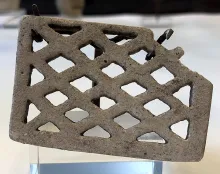
21. Lattice Screen and Curved Fragment Dr. Kenoyer (Ancient Cities, p. 58) writes: "Windows situated on both the first and second stories had shutters with latticework grills above and below the shutters. This allowed air and light into… |
|
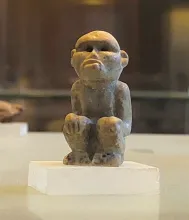
22. Monkey Figurine Another example where Indus craftsmen are able to imbue a tiny figurine with indelible character. Marshall wrote (Mohenjo-daro, pp. 351): "No 13 (DK 2091), which is 1.5 inches high, is a delightful… |
|
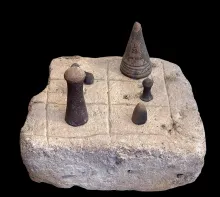
23. Gameboard Apparently half-of a burnet brick that seems like it could have been a gameboard, found in the DK area of Mohenjo-daro. Note that the conical piece is likely not a gaming piece but a pointed cone… |
|
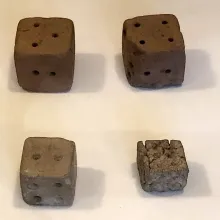
24. Indus Dice Dr. Kenoyer writes (Ancient Cities, p. 120): "Many carved objects from the Indus cities are made of valuable materials such as shell or ivory, and may have been used in ritual games or the pastimes… |
|
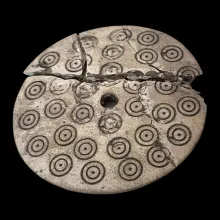
25. Disc Possibly a counting or prayer disc, made of bone. 5.8 cm in diameter, 0.45 cm thick. Note how perfectly the circles are impressed. Found in the VS Area. In a previous post I had argued that the total… |
|
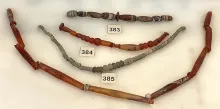
26. Carnelian Beads The long carnelian beads at the bottom of this image are among the most distinctive products made during the height of the ancient Indus civilization. Dr. Kenoyer writes (Ancient Cities, pp. 162): … |
|
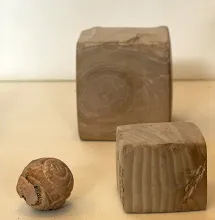
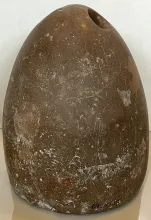
27. Weights The National Museum of Pakistan description is shown below, although the conical piece in the lower left is a carved shell object and not a weight: "A large number of stone weights have been found… |
|
28. Three Large Weights Sir John Marshall writes about weights (there are three candidates shown above) Mohenjo-daro (p. 461): "The large number of weights that have been found at Mohenjo-daro, in small houses as well as… |
|
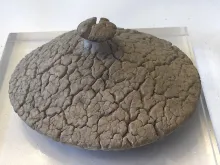
29. Alabaster Lid Fractures run splendidly through this small alabaster jar lid. |
|
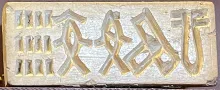
30. Long Rectangular Seal Another exceptionally well-preserved seal. Shown in the Image 2 [above] with its sealing from Shah, S. G. M. and A. Parpola, Corpus of Indus Seals and Inscriptions. 2. Collections in Pakistan (p. XXV… |
|
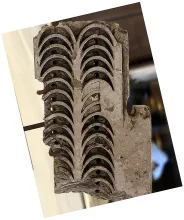
31. Steatite with Paste Inlay One of the most mysterious of pieces in the gallery. It rests horizontally in the display case but has been straightened here because to me it looks like some sort of tree or tree-themed altar, which… |
|
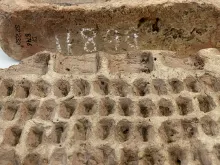
32. Gameboard? Ernest J.H. Mackay identified this piece as a gameboard, and wrote in Further Excavations (p. 574-5): "We have been fortunate in finding two boards on which same kind of game was played, though… |
|
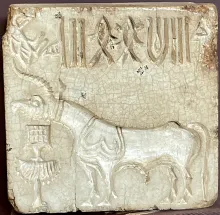
33. Unicorn Seal Another extremely well-preserved seal, about which Dr. Mark writes (Ancient Cities, p. 189): "Large square unicorn seal with perforated boss on the back. A relatively long inscription of eight… |
|
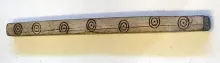
34. Counting Rod On this rod "with circles and lines, carved in ways that do not correspond to dice, may have been used for predicting the future (fig. 6.41)," writes Dr. Kenoyer (Ancient Cities, p. 120). Another… |
|
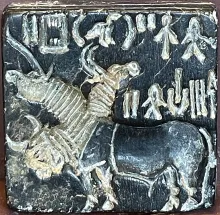
35. Composite Seal Describing another composite animal seal with the same three animals – short-horned bull or bison, unicorn and goat – Dr. Kenoyer writes (Ancient Cities, p. 194): "Square seal with multiple… |
|
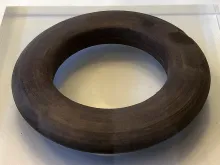
36. Stoneware Bangle Dr. Kenoyer writes of this distinctive ancient Indus object (Ancient Cities, p. 145-46). "However, one style of bangle was always made the same size, between 5.5 and 6 cm interior diameter with a… |
|
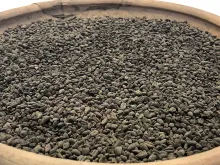
37. Charred Wheat Some of the burnt grains unearthed during excavations at Mohenjo-daro in the 1920s and 1930s. |
|
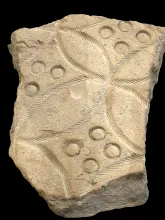
38. Indus Piece Baked terracotta with designs of intersecting leaves and impressed circles. Mohenjo-daro, L-Area, 24 x 17 cm. |
|
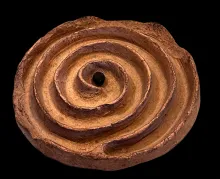
39. Terracotta Puzzle like Object This puzzle or even toy was found in Mohenjo-daro. The little ball at the center was put there by the museum authorities to suggest that it could have been used to make a ball travel in circles, like… |