
Home

Main navigation

  • home
  • slides
  • essays
  • articles
  • books
  • video
  • q & a
  • blog
Secondary menu
  • about us
    • scholars
    • privacy
    • support
    • image rights
    • credits
    • contact us
  • resources

Burials at Harappa

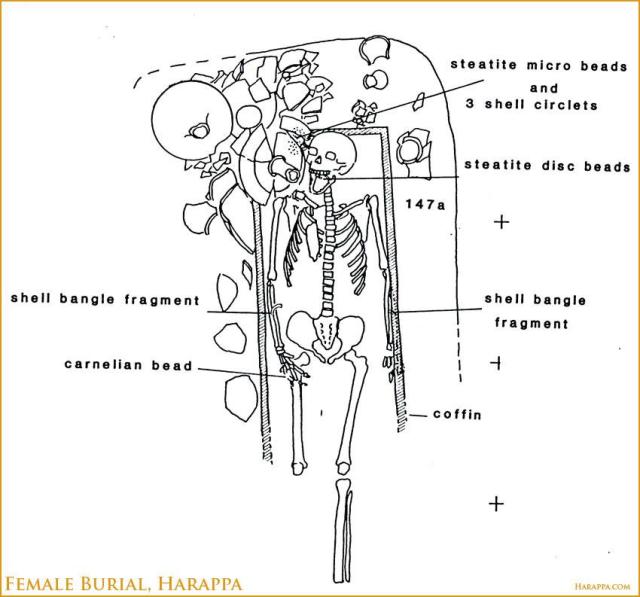
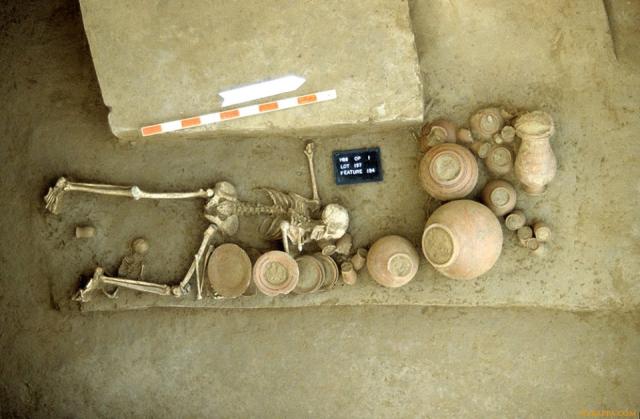
  • The most prominent pendant bead is made of a rare variety of onyx with natural eye designs in alternating shades of red, white, tan and green. Gold beads were placed at each end to frame this important ornament. The other two stone beads were made of banded jasper and turquoise, with a single gold bead at one end of the turquoise bead. "Four burials of what are probably adult females were found with shell bangles on their left arms. The bangles were arranged on both the lower and upper arm, with the characteristic Harappan chevron motif pointing counter clockwise. One burial had 14 shell bangles, another had seven, another had five, only had only two." (Richard H. Meadow, Harappa Excavations 1986-1990: A Multidisciplinary Approach, p. 194.) His burial was disturbed in antiquity, possibly by ancient Harappan grave robbers. Besides the fact that the body is flipped and the pottery disturbed, the left arm of the woman is broken and shell bangles that would normally be found on the left arm are missing. The infant was buried in a small pit beneath the legs of the mother.
    The most prominent pendant bead is made of a rare variety of onyx with natural eye designs in alternating shades of red, white, tan and green. Gold beads were placed at each end to frame this important ornament. The other two stone beads were made of banded jasper and turquoise, with a single gold bead at one end of the turquoise bead. "Four burials of what are probably adult females were found with shell bangles on their left arms. The bangles were arranged on both the lower and upper arm, with the characteristic Harappan chevron motif pointing counter clockwise. One burial had 14 shell bangles, another had seven, another had five, only had only two." (Richard H. Meadow, Harappa Excavations 1986-1990: A Multidisciplinary Approach, p. 194.) His burial was disturbed in antiquity, possibly by ancient Harappan grave robbers. Besides the fact that the body is flipped and the pottery disturbed, the left arm of the woman is broken and shell bangles that would normally be found on the left arm are missing. The infant was buried in a small pit beneath the legs of the mother.

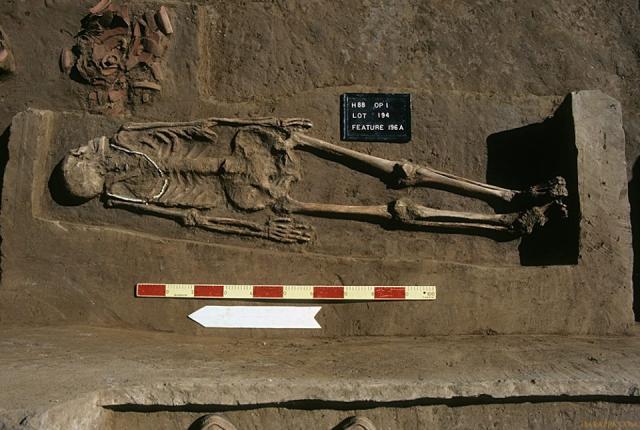
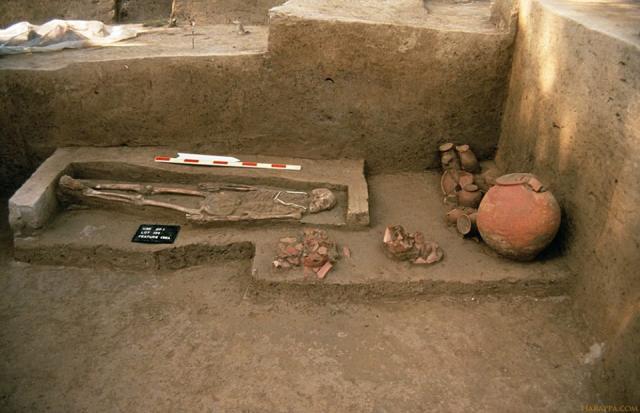
The body may have been wrapped in a shroud, and was then placed inside a wooden coffin, which was entombed in a rectangular pit surrounded with burial offerings in pottery vessels. The man was buried wearing a long necklace of 340 graduated steatite beads and three separate pendant beads made of natural stone and three gold beads. A single copper bead was also found at his waist.

Note that the entire book describing these discoveries, Harappa Excavations 1986-1990: A Multidisciplinary Approach edited by Richard H. Meadow is available with each chapter a single PDF download. These are basically the most comprehensive, scientific publications about a single ancient Indus excavation site yet.

See also Another Skeleton from Harappa and Painted Burial Pottery.

People

Blog Posts by Subject (16)
  • Animals
  • Art
  • Children
  • City Life
  • Conferences
  • Crafts and Industry
  • Evolution
  • Excavations
  • Food
  • Homes
  • Media
  • Museums
  • Mysteries
  • News
  • People
  • Seals
© Harappa.com 1995-2026 31