Home

Main navigation

  • home
  • slides
  • essays
  • articles
  • books
  • video
  • q & a
  • blog
Secondary menu
  • about us
    • scholars
    • privacy
    • support
    • image rights
    • credits
    • contact us
  • resources

Black and White Ancient Indus Civilization Images

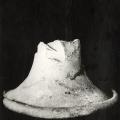
Top of a Colossal Clay Jar

Whether or not this was one of the first objects discovered in Trench A, given the catalogue number 2, is unclear, but it was unusual to Daya Ram Sahni who said he had not seen something of the sort before, with an opening over a foot across. About … >

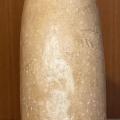
Linga?

Sir John Marshall has an extensive section (see Images 2 and 3 for his references) on linga, yoni and the often difficult job of distinguishing them from game pieces and stones in general (Mohenjo-daro, p. 58-63). We reproduce the entire section fro… >

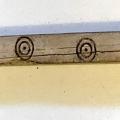
Counting Rod

On this rod "with circles and lines, carved in ways that do not correspond to dice, may have been used for predicting the future (fig. 6.41)," writes Dr. Kenoyer (Ancient Cities, p. 120). Another ivory object in the gallery. >

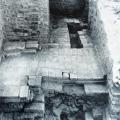
A Prehistoric Shrine at Mohenjo-daro

FLOORING AND CONDUIT OF GLAZED BRICK; A PREHISTORIC SHRINE AT MOHENJO-DARO >

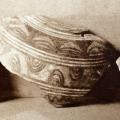
Polychrome Pottery

INDICATING A HIGH DEGREE OF DECORATIVE ART IN THE PREHISTORIC PERIOD AT MOHENJO-DARO: THREE FRAGMENTS OF POLYCHROME POTTERY WITH DESIGNS OF VARIOUS PATTERNS. >

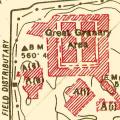
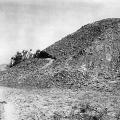
Mound F

Mound F, which Sahni for a while called the "Parallel Walls" area and was later called by Sir John Marshall and others the "Granary" although this is not widely accepted anymore. The second slide above shows Mound F in the context of the old bed … >

Excavation Site

It was one of 388 unicorn seals found during the excavations in Mohenjo-daro led by the British archaeologist Ernest Mackay between 1927 and 1931. Mackay dated the seal to the late Period IB, or approximately 2,000 B.C >

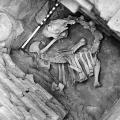
Camel Skeleton Mohenjo-daro [34]

  • Camel Skeleton Mohenjo-daro

Area not known Overview of a camel skeleton (Camelus sp.) that was buried in a pit associated with buildings made from complete and broken Harappan. Meadow (1984:134) suggests that the structures were built in the later part of the Harappan Perio… >

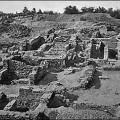
Western Edge, Mohenjo-daro Granary [60 / 48?]

  • Western Edge, Mohenjo-daro Granary

REM Granary Looking north along the western edge of the REM Granary area during the early phase of excavations. The slope is covered with eroded bricks and pottery. Lighter areas are probably mudbrick walls or platforms. No. … >

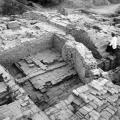
Northwest Corner, Granary Excavations, Mohenjo-daro [138]

  • Northwest Corner, Granary Excavations, Mohenjo-daro

REM Granary Overlooking the northwest corner of the REM Granary excavations. A stairway indicates the presence of a second story. Square voids in the edges of the walls are where wooden posts would have been built into the brick foundation to sup… >

Pagination

  • First page
  • Previous page
  • Page 1
  • Page 2
  • Page 3
  • Page 4
  • Page 5
  • Page 6
  • Page 7
  • Page 8
  • Page 9
  • …
  • Next page
  • Last page
© Harappa.com 1995-2026 31