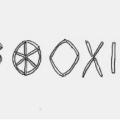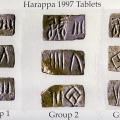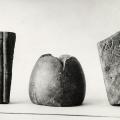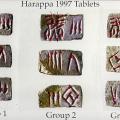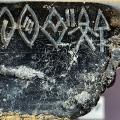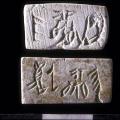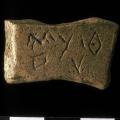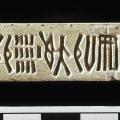
This type of seal is only found in the last part of the Harappan Phase, Period 3C. A similar rectangular seal was found on Mound F in the 1998 excavations of the circular platforms (Trench 43). >
This pottery bat from Trench 54 at Harappa has pre-firing inscription on the underside, inside a ring base that would have allowed the bat to be centered snugly on top of the wooden head of a potter's wheel (H2000-5050/2102-1811) >
Inscribed lead celt or ingot fragment from the Trench 54 area (H2000-4481/2174-321). The object was apparently chiseled to reduce its size. Lead may have been used as an alloy with copper, for making pigments, or as medicine. >
This uniquely shaped tablet (H2001-5090/2913-09), also made with two colors of faience, has an inscription similar to that seen on the previous slide (67). This tablet was found inside the workshop in Trench 54 South. >
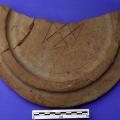
The origins of Indus writing can now be traced to the Ravi Phase (c. 3300-2800 BCE) at Harappa. Some inscriptions were made on the bottom of the pottery before firing. Other inscriptions such as this one were made after firing. This inscription (c. … >
Inscribed steatite tablets made from two different colors of steatite have the same inscription. The sloppy nature of the inscription may be the reason why these tablets were discarded. Both tablets, incised on one side only, were found in the same … >
These particular symbols made on the bottom of terra cotta vessels prior to firing were probably made by potters during the Kot Dijian Period in order to identify their own vessels or ones being made for specific customers. Some of these single pre-… >
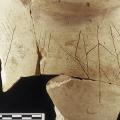
This fragment of a mold used for making large storage jars has three pre-firing graffiti signs. Such symbols when combined together may have served to indicate the name of the owner rather than just being abstract symbols. This piece dates to the en… >