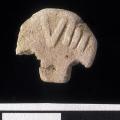
Fan-shaped molded faience tablet found on the eroded slope south of the Trench 54 South workshop. It was probably made using the steatite mold found in the workshop (Slide 64). >
Faience tablet (H2001-5082/2920-02) made from two colors of faience was found eroding from the Trench 54 South workshop area. Identical tablets made from two colors of faience were recovered in Area J, at the south end of Mound AB, in the excavation… >
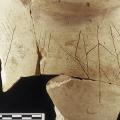
Many large storage jars of the Harappa Phase (2600-1900 BCE) have writing inscribed along the upper portion of the vessel. This inscription includes a figure of a man with the bow and arrow sign in each hand. It is impossible to shoot two bows and a… >
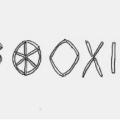
A 10 lettered signboard found in the western chamber of North Gate of Castle, (c. 2500-1900 BC). There are ten symbols in the panel. One symbol has been repeated four times. These symbols are indicative of use in Stage IV of Harappan Culture. These … >
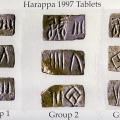
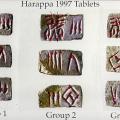
Three groups of tablets can be defined on the basis of the type of tool used to incise them and the style of inscribing. The most complex script sign appears to have been made with different numbers of strokes for each of the three groups. This sign… >
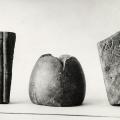
Left: Inscribed pottery Middle resembles no. 21, in Vats 1940 (Vol. II) Pl LXXXIII. Vats described this and another (no. 20) as quatrefoil cones. See Photo 54 for description of 20. “… No. 21 (PII-20) of red sandstone. This latter is the best… >
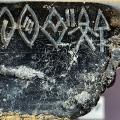
One of the most intriguing of Indus inscriptions, displayed upside down in the glass case in the second image [above]. Was it going to be a seal or not? It looks like it. Dr. Kenoyer points out that "The depression under the script is the beginning … >
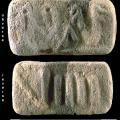
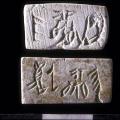
These two inscribed tablets (c. 2300 BCE) have the same inscription, but it was written in opposite directions. What is even more interesting is that the top tablet is incised with the same "handwriting" as the Group 2 tablets described in (59). The… >
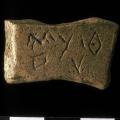
Most inscribed sherds are part of larger vessels that were inscribed and then broken. This object (c. 2300 BCE) was inscribed as a sherd. It is clear that broken sherds were occasionally used as a form of "scrap paper" to send notes or serve as temp… >