Home

Main navigation

  • home
  • slides
  • essays
  • articles
  • books
  • video
  • q & a
  • blog
Secondary menu
  • about us
    • scholars
    • privacy
    • support
    • image rights
    • credits
    • contact us
  • resources

Ancient Indus civilization writing.

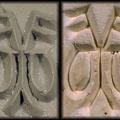
Stone Objects Harappa

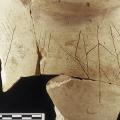
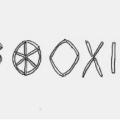
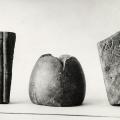
Left: Inscribed pottery Middle resembles no. 21, in Vats 1940 (Vol. II) Pl LXXXIII. Vats described this and another (no. 20) as quatrefoil cones. See Photo 54 for description of 20. “… No. 21 (PII-20) of red sandstone. This latter is the best… >

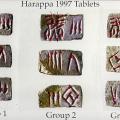
Stroke direction

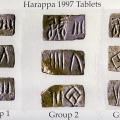
The red arrows indicate the direction of strokes used to incise each group of tablets. >

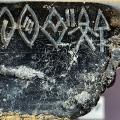
An Unfinished Unfired Seal

One of the most intriguing of Indus inscriptions, displayed upside down in the glass case in the second image [above]. Was it going to be a seal or not? It looks like it. Dr. Kenoyer points out that "The depression under the script is the beginning … >

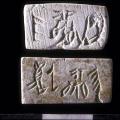
Two inscribed tablets

These two inscribed tablets (c. 2300 BCE) have the same inscription, but it was written in opposite directions. What is even more interesting is that the top tablet is incised with the same "handwriting" as the Group 2 tablets described in (59). The… >

Inscribed sherd, Harappa Phase

Most inscribed sherds are part of larger vessels that were inscribed and then broken. This object (c. 2300 BCE) was inscribed as a sherd. It is clear that broken sherds were occasionally used as a form of "scrap paper" to send notes or serve as temp… >

Long rectangular seal with no animal motif

This type of seal is only found in the last part of the Harappan Phase, Period 3C. A similar rectangular seal was found on Mound F in the 1998 excavations of the circular platforms (Trench 43). >

Pottery bat with inscriptions

This pottery bat from Trench 54 at Harappa has pre-firing inscription on the underside, inside a ring base that would have allowed the bat to be centered snugly on top of the wooden head of a potter's wheel (H2000-5050/2102-1811) >

Inscribed fragment

Inscribed lead celt or ingot fragment from the Trench 54 area (H2000-4481/2174-321). The object was apparently chiseled to reduce its size. Lead may have been used as an alloy with copper, for making pigments, or as medicine. >

Pagination

  • First page
  • Previous page
  • Page 1
  • Page 2
  • Page 3
© Harappa.com 1995-2026 31