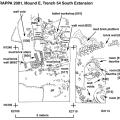
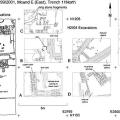
Plan view of the portion of perimeter wall [250] excavated in 2001. The pattern of the bricks suggests a complicated series of additions to the inside of the structure that are not yet well understood. There may have been a gateway at the northweste… >
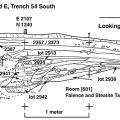
In the South, perimeter wall [250] was preserved to a lesser altitude than in the North. In the very south of the area excavated in 1996, the lower portions of the walls of a mud-brick room were found attached to the inside of the perimeter wall nex… >
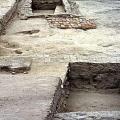
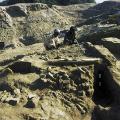
The excavations of the lower slope area of Trench 54 South revealed a robbed brick wall void filled with rubble (foreground) and a room filled with manufacturing debris from faience and steatite working. >
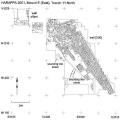
Excavations during the 1997-2001 seasons were carried out inside perimeter wall [250]. Here a partial plan of those excavations shows superimposed levels of Period 3C buildings, all mostly robbed of their baked brick walls. [Mud-bricks are hatched, … >
Towards the east, in what was probably a low area, a series of radiating mud-brick retaining walls were built to contain rubble that was used as a foundation for later structures, only fragments of which are preserved. In the rubble were found a gre… >
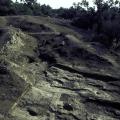
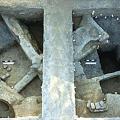
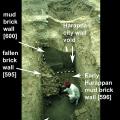
View of excavations on the west side of Trench 54 where brick robbers had removed several massive Harappan Period baked brick walls (c. 2600-1900 BC, Harappa Period 3). At the bottom of the brick robber trench are remains of the Harappan walls and a… >