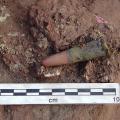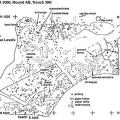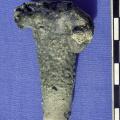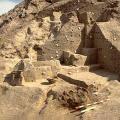
Excavations in 1996 revealed two Period 2 small kilns for making figurines and bangles, as well as preserved floors with Kot Diji style pottery, beads, and figurines >
Experimental efforts to manufacture and fire faience and steatite tablets were undertaken by J. Mark Kenoyer in Madison, Wisconsin, during the summer of 2001. >
This room in VS area was made with bricks set on edge to create a watertight floor. A small well was located in the southeast corner (top right) and circular brick depressions were set into the floor, presumably to hold pottery vessels. The early ex… >
Stages in the manufacture of faience tablets. First it is necessary to make the faience paste and the steatite molds. Then the paste is formed into a rectangle and impressed on both sides by the molds. Finally the molded tablets must be dried slowly… >
The bead factories, situated where the 8th street of the commercial area and the 5th street of the residential area meet, comprised the main industry of the Harappans. They probably settled (or their culture came) to the Gulf of Cambay region becaus… >
In order to glaze faience it must be fired at approximately 940 degrees Celsius for several hours. The red color of the glowing faience barely visible inside the canister indicates that this temperature has been reached. This was confirmed by using … >
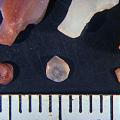
Fully and partially glazed faience tablets and other fired objects could be examined after the fire had cooled and the canister opened. The steatite molds were also included in the canister to see how they would be affected by this type of firing. >