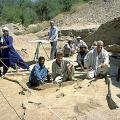
After marking, the entire excavation team is called in to map and eventually collect the bead manufacturing debris and all of the sediment from each layer of Ravi phase floors. >
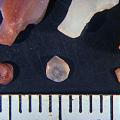
Tiny steatite microbeads (less than 1mm in diameter) such as those seen here were probably perforated with a sharpened copper wire, while stone drills with larger tips were used for carnelian, lapis, and amazonite beads. >
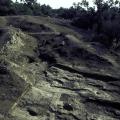
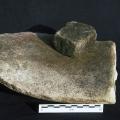
The excavations of the lower slope area of Trench 54 South revealed a robbed brick wall void filled with rubble (foreground) and a room filled with manufacturing debris from faience and steatite working. >
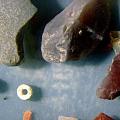
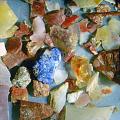
Flakes of various shades of agate, carnelian, jasper, chert, and lapis lazuli indicate the range of raw materials being processed in this part of Harappa during the Ravi phase. All of these raw materials were brought to the site from distant resourc… >
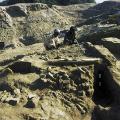
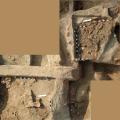
Composite overview of the steatite and faience workshop area in Trench 54 South taken using the bamboo ladder. Two images were pieced together on the computer to make this composite. North is to the right. >
During drilling, the tips of agate drills become hot and often spall off. Fine screens allow the collection of the spalled drill tips, the finding of which confirms that drilling as well as shaping of beads was done in this area of the site during t… >
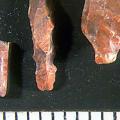
Jasper drill bits were used for drilling carnelian and amazonite beads during the Ravi and subsequent phases at Harappa. On the left are two snapped drill tips while on the right is a broken drill base. All are from the Ravi phase. >
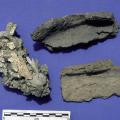
Broken canisters, often with glassy vitrified surfaces, were found throughout the Trench 54 South workshop debris. Lumps of frothy faience slag with embedded fragments of bone were also quite common in the debris. >