Home

Main navigation

  • home
  • slides
  • essays
  • articles
  • books
  • video
  • q & a
  • blog
Secondary menu
  • about us
    • scholars
    • privacy
    • support
    • image rights
    • credits
    • contact us
  • resources

Fish objects and signs from ancient Indus Civilization sites.

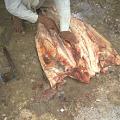
Preparing a fish to be dried and salted

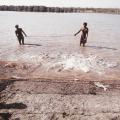
In the fishing village, fish are prepared for drying. The heads and gills are removed and the fish is split up the middle along its belly. Slits are cut into the meat and salt is spread in to help the drying process. With the small catches that are … >

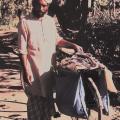
Getting the Fish to Market

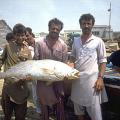
Most of the fisher folk have a low-tech way of getting the fish to the market – primarily burlap bags and a bicycle. Often the fish are sold to passers-by as the fisher folk will have a scale to weigh the fish in kilograms. I was surprised on the … >

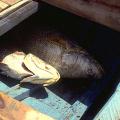
Fish in brine pit

Medium and large fish are then placed into a brine pit and soak up salty brine before being placed in the sun. The meat is not usually used for human consumption, although it is traded into the interiors of Baluchistan and Sindh Provinces. The small… >

Fish Markets

The main fish markets near the modern village of Harappa were within the village itself as well as the District market in the local District center, Sahiwal. Most of the fish within the local market of Harappa were supplied through local fisher fol… >

Sua fish bone

Through the study of butchery and fishing practices, it is possible to reconstruct behaviors that occurred in the past. These cut marks on a sua fish (Protonibea diacanthus) mid-body vertebra are approximately 4,500 years old and originate from the … >

Fisher Folk – Baba Yaqoob

One of my main informants in Harappa Town was an elderly man named Baba Yaqoob. He was retired at the time during the mid-1990s, while his sons worked their land as well as a vegetable stand on the western side of Harappa. Baba Yaqoob took me into h… >

Dhoter Fish Remains, Balakot

Also recovered from Balakot were the distinctive neurocrania of the dhoter fish (Pomadasys hasta). This fish account for almost 60% of all the fish remains at Balakot. Neurocrania and other cranial remains are concentrated in very distinct areas of … >

Fisher Folk - Gulam Mustafa

Gulam Mustafa was one of my main fisher folk informants. He had several businesses that he ran, but he also had a lot of knowledge and the equipment related to fishing. He helped procure many of the fish remains that were part of the butchery and … >

Fish Bone/Wallago Attu Mandible/Dentary in Situ at Harappa

In the early 1990s, I was a new graduate student in the Department of Anthropology at the University of Wisconsin-Madison. In order to prepare myself for taking my qualifying exams, I was sitting in on Dr. J. Mark Kenoyer’s class, The Archaeology o… >

Terracotta animals and miscellaneous objects

Four terracotta animal figures in a row. Left: possibly an armadillo, find no. Ab 923, found in Mound F in the parallel wall area, and which is published in Vats 1940 (Vol. II) Pl. LXXVII no. 26, and described by Vats: “No. 26 (Ab923) is a fine … >

Pagination

  • Page 1
  • Page 2
  • Page 3
  • Next page
  • Last page
© Harappa.com 1995-2026 31