"Objects used for games are not many. Those that may be said to be unmistakable are balls and marbles in stone, shell, faience and pottery; dice of the same materials except shell; and some gamesmen of tetrahedral or chessman shape, the latter hardly distinguishable from baetyls." >
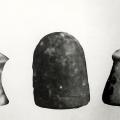
Sir John Marshall writes about weights (there are three candidates shown above) Mohenjo-daro (p. 461): "The large number of weights that have been found at Mohenjo-daro, in small houses as well as large, suggests that the housewife realized the n… >
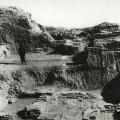
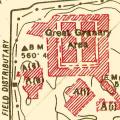
Mound F, which Sahni for a while called the "Parallel Walls" area and was later called by Sir John Marshall and others the "Granary" although this is not widely accepted anymore. The second slide above shows Mound F in the context of the old bed … >
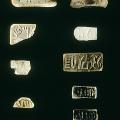
A collection of seals and tablets from a single house along the main street leading to the southern gateway of Mound E at Harappa. The association of these different types of objects together in one house show that some people, possibly merchants, w… >
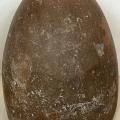
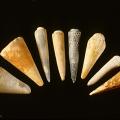
Decorated terra cotta cones are found at both Mohenjo-daro and Harappa, but no one knows what they may have been used for. Some scholars suggest that they were hung on a string as a plumb-bob for use by masons and carpenters. Others feel that they m… >
Excavations in Trench 39 South on Mound AB in 1996 revealed an extensive deposit of the Kot Diji phase occupation dating to between 2800 and 2600 BC. A geometric button seal (38) was found in the upper part of this rectangular Trench 39 South. White… >
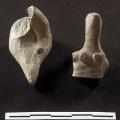
Early Harappan (Kot Dijian Phase, Period II) female figurines are often broken. On the left is the lower half of a figurine, showing wide hips and pointed legs. On the right is the upper half of a figurine with traces of painting. >
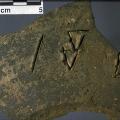
This fragment of a mold used for making large storage jars has three pre-firing graffiti signs. Such symbols when combined together may have served to indicate the name of the owner rather than just being abstract symbols. This piece dates to the en… >
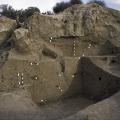
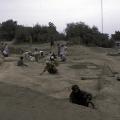
Clearing the ancient Harappan debris from the eroded surface outside of the mud brick city wall at the eastern edge of Mound E. In 1997 this area of Trench 11 was cleared to define the stratigraphic sequence between Period 3B and 3C. It was possible… >