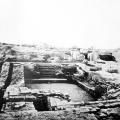
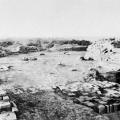
[Original 1931 text] "The Great Bath, which I have reserved to the last, was part of what appears to have been a vast hydropathic establishment and the most imposing of all the remains unearthed at Mohenjo-daro." (Marshall, Vol. I, p. 24) >
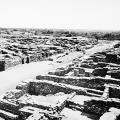
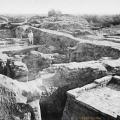
[Original 1931 text] "The northern part of this street, 145 feet in length, had been dug by Mr. Hargreaves in 1925-26, the rest of the street, some 300 feet in length, was completely exposed by me down to the Intermediate level, the work involving t… >
It was one of 388 unicorn seals found during the excavations in Mohenjo-daro led by the British archaeologist Ernest Mackay between 1927 and 1931. Mackay dated the seal to the late Period IB, or approximately 2,000 B.C. >
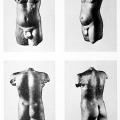
[Original 1931 text] "The treatment of the red stone torso could hardly be simpler or more direct. The pose is a frontal one with shoulders well back and abdomen slightly prominent; but the beauty of this little statuette is in the refined and wonde… >
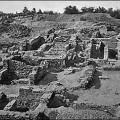
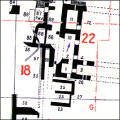
Mackay writes about the large building in Block 22 (p. 152): "At the floor level of the Late II Phase this building measured 51 feet 3 inches, North-South, by 56 ft. long at the north and about 54 feet 9 ins. at the south. The thickness of its wa… >
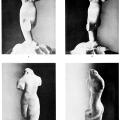
[Original 1931 text] "It is the figure of a dancer standing on his right leg, with the body from the waist upwards bent well round to the left, both arms thrown out in the same direction, and the left leg raised high in front. . .. Although its cont… >