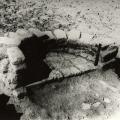
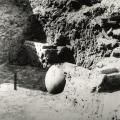
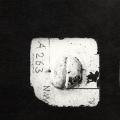
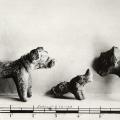
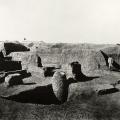
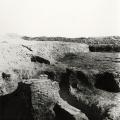
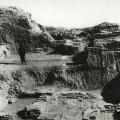
Circular Hearth in eastern portion of trench A (f) from S.E. There is no mention of a circular granary from trench A(f), Mound F, in ARASI 1924-25. However, Sahni noted “two little circular structures paved in brick on a thick substratum of hard … >
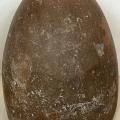
"The discovery at Harappa of the very remarkable seal illustrated in figure 1 of Cunningham's Plate XXXIII in this volume [see Image 2 above] and later of a few more now in the British Museum, suggested that at this site we have the remains of a cit… >
"Animal figures, mostly in terracotta, have been found in very large numbers at Harappa. They are also fairly common in faience, specially the squirrels and rams, both of which were used as amulets. More rarely, they were made of steatite, shell and… >
Possibly the “narrow well” with the “steaning wall” only 11 inches thick, in Mound F trench A (e), which Sahni reported from the lowest excavated strata, and which he inferred was connected to the “reservoir” excavated in 1923-24: “In mound F whi… >
A view of a part of the area of Parallel walls, Mound F, possibly before deep digging. One thinner wall is exposed, and traces of the others visible. NOTE: Photos Block of Parallel Walls, Block of Parallel Walls and Harappa Walls are of the area … >
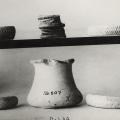
Two rows of six objects, each row has three. Four pieces of bangles, or bracelets, three with fine “incised linear patterns”, to quote Vats 1940, p. 448; Middle bottom row: a pot with find no Ab 607 Middle Top row: misc. Two bangles on … >
"Objects used for games are not many. Those that may be said to be unmistakable are balls and marbles in stone, shell, faience and pottery; dice of the same materials except shell; and some gamesmen of tetrahedral or chessman shape, the latter hardly distinguishable from baetyls." >
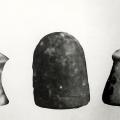
Sir John Marshall writes about weights (there are three candidates shown above) Mohenjo-daro (p. 461): "The large number of weights that have been found at Mohenjo-daro, in small houses as well as large, suggests that the housewife realized the n… >