
Mystery at Mound F, Harappa
The Circular Platforms and so-called Granary at Harappa, two puzzling structures. By Richard H. Meadow and Jonathan Mark Kenoyer.
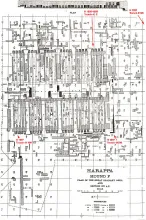
|
1. Plan view of the so-called "granary" at Harappa Plan view of the so-called "granary" or "parallel-wall structure" on Mound F at Harappa indicating areas of HARP excavations conducted in 1997 and 1999. Note that the structural remains surrounding… |
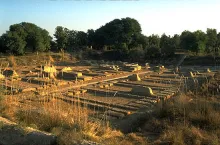
|
2. Overview of the Harappa "granary" area Overview of the "granary" area looking towards the southeast. The walls have been partly restored for conservation purposes by the Department of Archaeology and Museums, Government of Pakistan. |
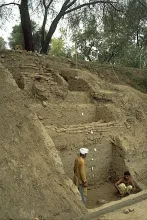
|
3. Excavations at the corner of the "granary" area Excavations in 1997 at the southeast corner of the "granary" area were undertaken to recover a full sequence of pottery, architectural features, and inscribed objects. Here workers have found a seal… |
|
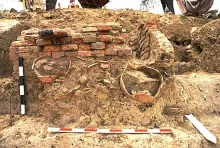
4. A small baked brick structure with sump pots In the upper levels of a small baked brick structure with sump pots was found. This structure, possibly a latrine, is on the northern margin of a major east-west street that ran along the southern… |
|
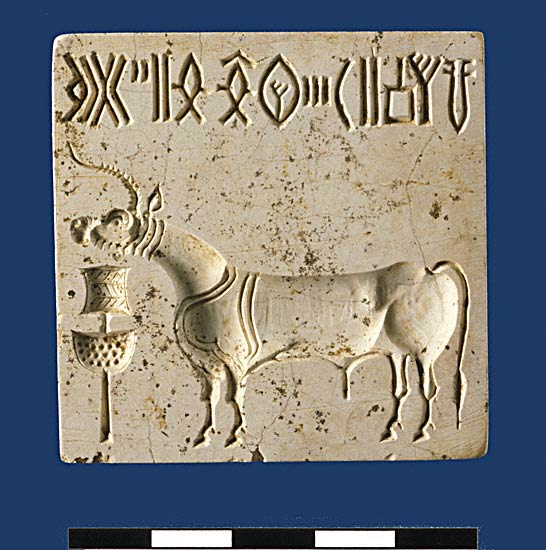
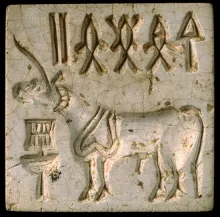
5. Intaglio seal with script and unicorn Intaglio seal (H97-3433/7617-01) with script and unicorn motif found in Trench 41NE in 1997. This seal dates to approximately 2200 BCE, at the transition between Harappa Periods 3B and 3C. |
|
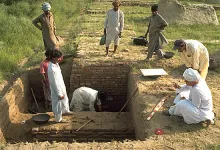
6. Baked brick revetment of the "granary" platform J. Mark Kenoyer sitting in the right foreground takes notes during excavations at the southwest corner of the "granary" (Trench 1SW). The baked brick revetment of the "granary" platform is in the… |
|
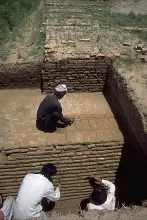
7. A massive baked brick revetment wall A massive baked brick revetment wall [329] surrounds the solid mud-brick foundation platform [50] of the "granary" that measures approximately 51 meters north-south and 41 meters east-west. Based on… |
|
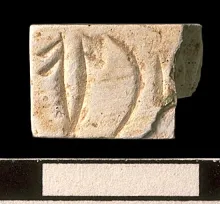
8. A broken steatite tablet A broken steatite tablet (H97-3431/7615-01) was recovered from deposits just below the fired brick revetment of the "granary" platform and dates to Harappa Period 3B (2450-2200 BC). |
|
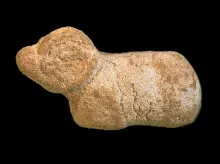
9. A small faience ram amulet A small faience ram amulet recovered from the fill associated with the southwestern edge of the "granary" platform. (Trench 41SW, H97-3434/7650-01, Length = 21.8 mm) |
|
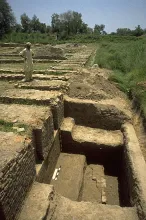
10. The northwest corner of the "granary" platform Excavations in 1997 at the northwest corner of the "granary" platform were undertaken to follow the outline of the structure and document its construction (Trench 1NW)). |
|
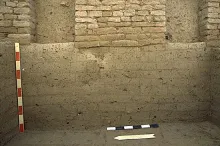
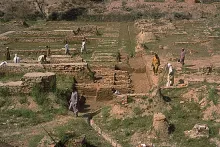
11. Northwestern portion of the "granary" platform Section through the northwestern portion of the "granary" platform directly below the baked brick "granary" walls (Trench 1NW). Similarity of composition of the mud-bricks in the northwestern,… |
|
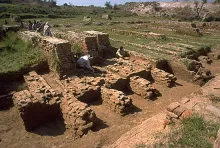
12. Excavations at the southeast corner of the "granary" structure Overview looking north of excavations at the southeast corner of the "granary" structure undertaken in 1999 (Trench 1C). The higher east-west running walls in the left of the image and the ruined… |
|
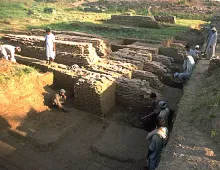
13. The original forms of the baked brick walls and hollow buttresses of the "granary" After clearing the overlying silt, the original forms of the baked brick walls and hollow buttresses of the "granary" could be made out. The three high walls in the upper left of the image are part… |
|
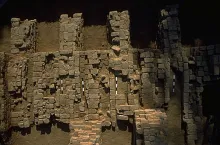
14. Clearing outside the southeast corner of the "granary" Clearing outside the southeast corner of the "granary" revealed the underlying mud-brick platform and the top of the baked brick revetment. |
|
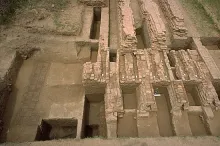
15. Aerial view of the exposed southeastern portion Aerial view of the exposed southeastern portion of the "granary" structure shows the nature of brick bonding and the empty sockets that would have held wooden beams and supports. |
|
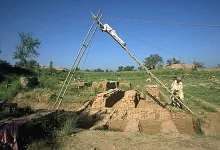
16. Photographing the southeastern portion Richard Meadow photographing the southeastern portion of the "granary" structure. |
|
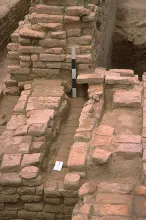
17. Deep digging at the southeast corner of the "granary" Deep digging at the southeast corner of the "granary" revealed an earlier building [wall 330] constructed along the same east-west alignment. This structure could have been built as early as the… |
|
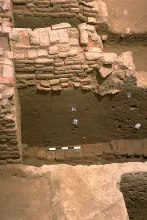
18. Detail view of a hollow area Detail view of a hollow area that would originally have held a wooden beam bonded into the baked brick structure. In the background is a wall remnant from the later rebuilding of the "granary". |
|
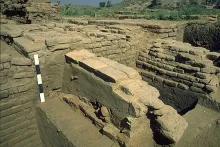
19. Hollow baked brick buttresses Hollow baked brick buttresses were later built up against the original "granary" structure on top of a shallow mud-brick platform [400] that itself overlies the mud-brick platform of the original … |
|
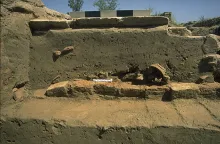
20. Excavation of one buttress Excavation of one buttress [99] shows how the silt and garbage from the street spilled into the hollow area from the outside of the "granary", eventually blocking it entirely. |
|
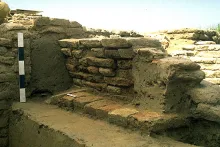
21. Detail view of the fill inside the "granary" buttress Detail view of the fill inside the "granary" buttress. Large pottery sherds, bone, and baked brick fragments lie on the bottom with finer silts on the top |
|
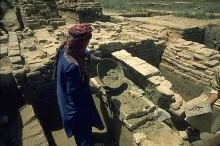
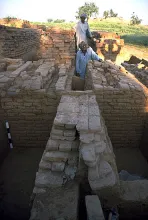
22. Granary without sediment and artifacts All of the sediment and artifacts were removed from "granary" buttress [99] for analysis, revealing the method of corbelled arch construction. |
|
23. Reconstruction of granary After excavation, "granary" buttress [99] was reconstructed using the original bricks set into modern clay mortar. |
|
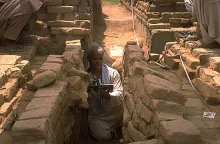
24. Excavations conducted in narrow space Excavations were conducted in the narrow space running west from the buttresses and between the interior walls to determine what was inside of the "granary" structure. |
|
25. J. Mark Kenoyer videoed the "granary" In addition to documentation with still photography, J. Mark Kenoyer videoed the "granary" areas excavated and narrated details of the stratigraphy and of the brick construction. |
|
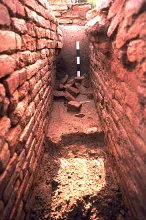
26. Empty channel between two "granary" walls This image looking east shows baked brick rubble and trash that had spilled through the corbelled arch of a buttress from the exterior street into a then empty channel between two "granary" walls. |
|
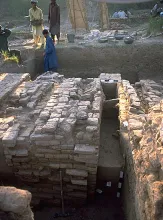
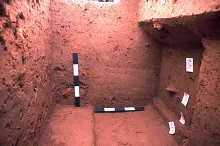
27. An interior area in the southeast part of the "granary" After clearing an interior area in the southeast part of the "granary", it became evident that the inner baked brick wall of the original structure had been dismantled by the ancient Harappans before… |
|
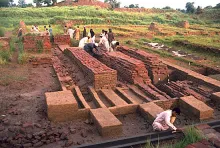
28. Looking toward the interior of the "granary" structure Looking toward the interior of the "granary" structure, the void of the original baked brick wall (vertical scale) is filled with small pieces of broken baked bricks and mud-brick rubble, while the… |
|
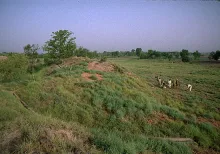
29. View, After completing the excavation After completing the excavation, the trenches were filled with sifted sediment and the "granary" structures were covered with a protective plaster made of clay and straw. |
|
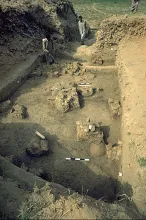
30. Excavations along the northeast perimeter of Mound F Excavations along the northeast perimeter of Mound F (Trench 41NE) identified traces of a massive mud-brick wall that protected the interior settlement (to the left) from floods and unwanted visitors… |
|
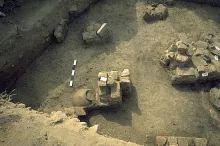
31. Harappa domestic structures with hearths and large jar Inside the city wall were domestic structures with hearths and large jars, part of structures that had encroached onto what used to be street along the inner face of the wall (Trench 41NE). |
|
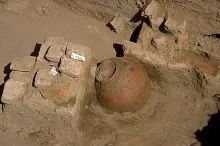
32. Detail of Harappa domestic structures Detail of domestic structures with hearths and large jars set into the floor (Trench 41 NE). |
|
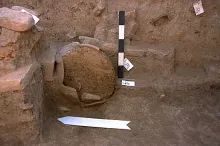
33. Large jar set into the floor of one of the small rooms, Harappa Detail of domestic structures with hearths and large jars set into the floor (Trench 41 NE). |
|
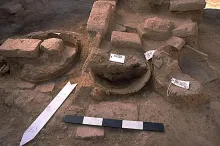
34. Excavation of the fill inside the jar Excavation of the fill inside the jar (image 33) indicates it was left exposed for some time and gradually filled with silt as the room became covered with debris (Trench 41NE). |
|
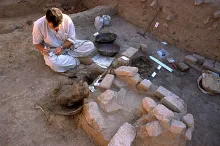
35. The upturned rim of a jar Also in a room encroaching onto the street were the upturned rim of a jar (on left) and two bases (center and right) that were used as hearths (Trench 41NE). The pottery base hearths could have been… |
|
36. William Belcher removing charcoal William Belcher has just removed charcoal for archaeobotanical analysis and radiocarbon dating from one of the hearths (image 35) and is making out a label for the sample. |
|
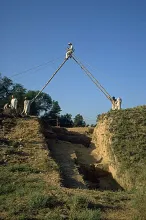
37. Richard Meadow photographing Richard Meadow photographing the exposed wall and interior domestic features (Trench 41NE). |
|
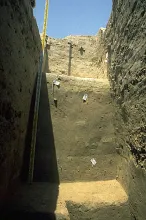
38. The interior part of the city wall The interior of the city wall shows mud bricks made from different colors of clay used during different phases of construction. |
|
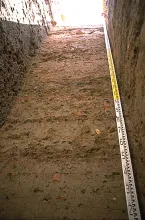
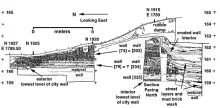
39. Superimposed street levels inside the city wall Superimposed street levels inside the city wall indicate that this area was kept clear until the last phase of the Period 3C occupation when structures were built encroaching onto the street (Trench… |
|
40. Mound F Harappa Section drawing Section drawing of the cut through the Mound F city wall and adjoining interior street, facing east (Trench 41NE). |
|
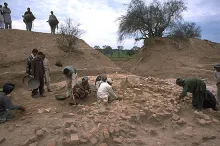
41. Drummers helping in excavations work, Harappa Excavations in 1999 along the western of edge of Mound F (Trench 43) revealed fallen rubble from walls that had collapsed late in the Harappan occupation of this area of the site. Drummers standing… |
|
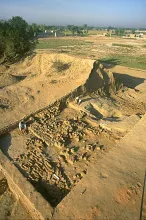
42. Overview of the upper levels of the excavations Overview of the upper levels of the Trench 43 excavations in 1999 shows the eroded city wall in the background and the fallen baked brick walls of late Period 3C structures in the foreground. |
|
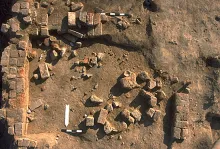
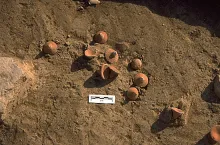
43. Interiors of the rooms filled with surprises After removing the fallen walls, the interiors of the rooms were found to be filled with surprises. Here in Room 202 were scattered clay tops, beads, and inscribed seals (Trench 43). |
|
44. Detail of terracotta tops Detail of terracotta tops found in Room 202 (Trench 43). |
|
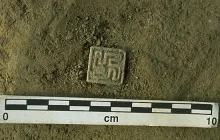
45. Faience button seal Faience button seal (H99-3814/8756-01) with swastika motif found on the floor of Room 202 (Trench 43). |
|
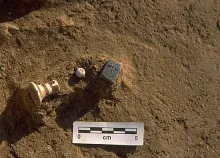
46. Glazed steatite, faience bead, and unfinished steatite seal Glazed steatite gaming piece, faience bead, and unfinished steatite seal (H99-3860/8756-30) from Room 202 (Trench 43). |
|
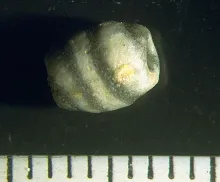
47. Black and white spiral faience bead Black and white spiral faience bead (H2000-5005/9845-48 from Trench 43). |
|
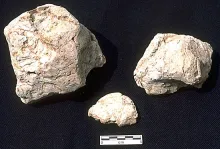
48. Large lumps of a bluish grey paste Large lumps of a bluish grey paste that may have been used to make faience objects. Faience is made by melting quartz rock and then regrinding the glassy frit to make a paste that is then fired once… |
|
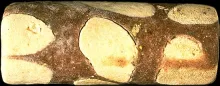
49. Harappa unique cylindrical object made of maroon and white faience Unique cylindrical object made of maroon and white faience from Harappa (H99-3856/8756-26 from Trench 43, length = 21.9 mm). Numerous examples of this identical type of bead have been found in other… |
|
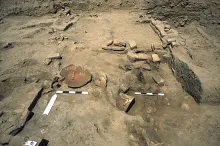
50. A broken terracotta bird cage A broken terracotta bird cage (near the scale at right) was discovered next to the remains of a broken storage jar that had been reused as a hearth (near the scale at left) (Trench 43). |
|
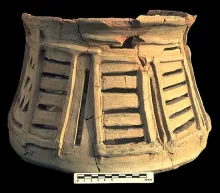
51. Reconstructed Bird Cage, Harappa Reconstructed bird cage (H99-4065/8768-7). On the other side it has a slot for a terracotta door, but no top was found. The exterior was decorated with red slip and black paint (Trench 43). |
|
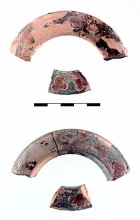
52. Terracotta bangle fragments Terracotta bangle fragments decorated with red trefoils outlined in white on a green ground from late Period 3C deposits in Trench 43. This image shows both sides of the two fragments (H98-3516/8667… |
|
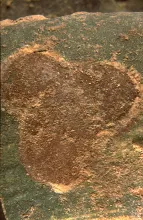
53. Detail of terracotta bangle, Harappa Detail of terracotta bangle with red and white trefoil on a green background (H98-3516/8667-01 from Trench 43). Trefoil motifs are carved on the robe of the so-called "priest-king" statuette from… |
|
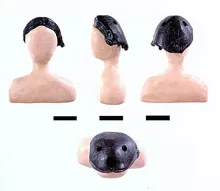
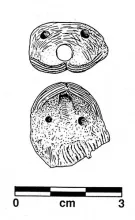
54. Black steatite wig, Harappa Black steatite wig from late Period 3C deposits in Trench 43 (H98-3521/8668-02). This small stone hairpiece, here displayed on a modern clay mannequin, may have been set on an alabaster head like… |
|
55. Drawing of black steatite wig Drawing of black steatite wig from Trench 43 (see image 54). |
|
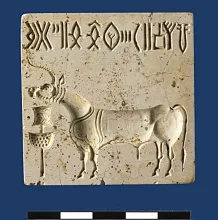
56. Large unicorn seal Large unicorn seal (H99-4064/8796-01) found on the floor of Room 591 in Trench 43, dating to late Period 3C. This is one of the largest seals found from any Indus site. |
|
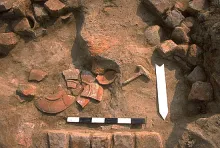
57. Collections of broken pottery Excavations in Trench 43 revealed collections of broken pottery that date to the final phases of the Harappan occupation of Period 3C, ca. 1900 BC. Note the antler piece (image 58) to the right of… |
|
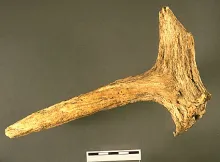
58. Part of an antler Part of an antler, including the burr and the brow tine, shed from a large deer, probably sambhar (Cervus unicolor) or swamp deer (Cervus duvauceli) (H99-3828/8763-01 from Trench 43). This specimen… |
|
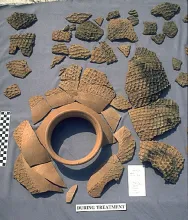
59. Late Harappan Vessel One of the falling walls in Trench 43 crushed a vessel that belongs to Harappa Period 4 (ca. 1900-1800/1700 BC). In this part of the mound, there appear to be transitional levels between the Harappan… |
|
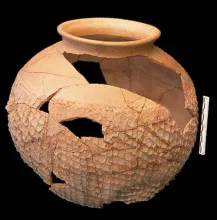
60. Late Indus Globular Pot This Period 4 globular pot (H99/8763-503) was found crushed beneath a fallen wall in Trench 43 (see image 59). The rough textured exterior was covered with a thick layer of blackened clay that… |
|
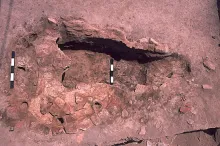
61. Late Indus Reconstructed Pot Period 4 globular pot (H99/8763-503) from Trench 43 after reconstruction. (See images 59 & 60). |
|
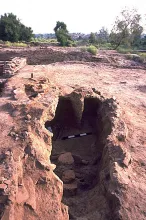
62. Harappan Kiln Period 4 (Late Harappan transitional) kiln with hollow lower fire box and arched floor with holes for allowing heat to enter the upper firing chamber. This type of kiln was introduced at Harappa ca… |
|
63. Late Indus kiln fire box Looking into the hollow fire box of the Period 4 kiln with arched floor (see image 62). The column of soil in the center was left for support of the floor (Trench 43). |
|
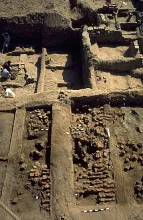
64. Well preserved ancient Indus living floors Continued excavations in 2000 focused on the northern area of Trench 43. Here too were found fallen walls and well preserved living floors. Note the Period 3C circular platform in the background at a… |
|
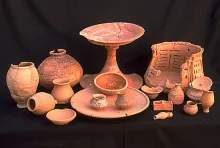
65. Late Harappan Pottery Collection of reconstructed pottery from the late levels of Trench 43. These shapes include the final Harappan forms (late Period 3C) and transitional Late Harappan period shapes (Period 4). |
|
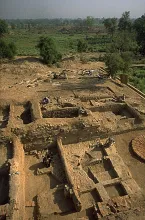
66. Circular platform and the "Granary" area , Harappa Overview of Trench 43 in 2000 looking north, showing the HARP-exposed circular platform in the foreground and the "granary" area in the background. Note the wall voids to the west, south, and east of… |
|
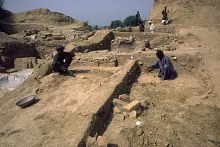
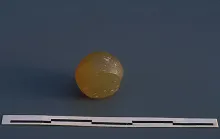
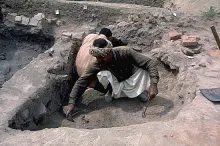
67. Ancient Indus weight discovery Pakistani excavators working in Trench 43. The man on the right has just discovered a spherical agate weight (image 68) while cleaning the section for photography. |
|
68. Spherical agate weight with one side flattened Spherical agate weight with one side flattened (H2000-4496/9880-01). This weight does not conform to the standard Harappan weight system and may indicate the use of a separate weight system for… |
|
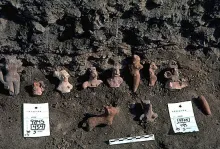
69. Excavation in progress Excavations of a large late Period 3C pit in Trench 43 resulted in the discovery of many broken figurines of humans and animals. |
|
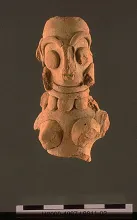
70. Collection of human and animal figurines Collection of human and animal figurines from a large refuse dump in a pit in Trench 43. |
|
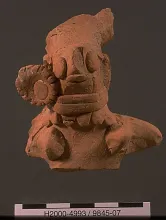
71. Female figurine Female figurine (H2000-4997/9811-02) from Trench 43. |
|
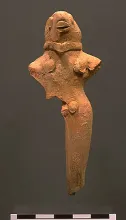
72. Female figurine Female figurine (H2000-4993/9845-07) from Trench 43. |
|
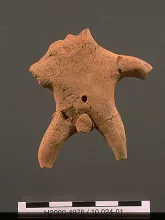
73. Male figurine Male figurine (H2000-4975/9878-07) from Trench 43. |
|
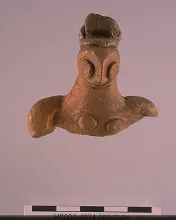
74. Male figurine Male figurine (H2000-4976/10,024-01) from Trench 43. |
|
75. Male figurine Male figurine (H2000-4974/9845-01) from Trench 43. |
|
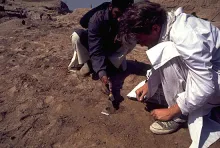
76. Excavating a red stoneware bangle Randall Law and Shamoon excavating a red stoneware bangle in Period 3C levels just below the surface in Trench 43. |
|
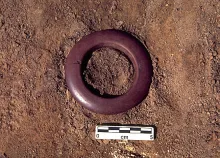
77. Red stoneware bangle Red stoneware bangle (H2000-4490/9843-01) with no inscription. The lack of inscription may indicate that this may have been a place where the bangles were stored prior to inscribing them for… |
|
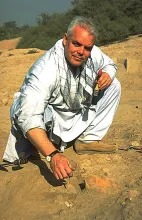
78. Discovering a broken unicorn seal While clearing a floor area in Trench 43, J. Mark Kenoyer discovers a broken unicorn seal. |
|
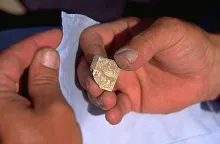
79. Unicorn seal Unicorn seal (H2000-4500/10007-01) found on the floor of Room 603 in Trench 43 (image 78), before conservation. |
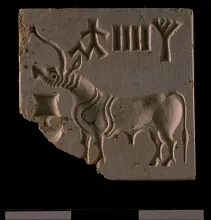
|
80. Unicorn seal Unicorn seal (H2000-4500/10007-01) after conservation. Note the deeply chiseled engraving of the script similar to that found particularly on Period 3C rectangular seals. |