

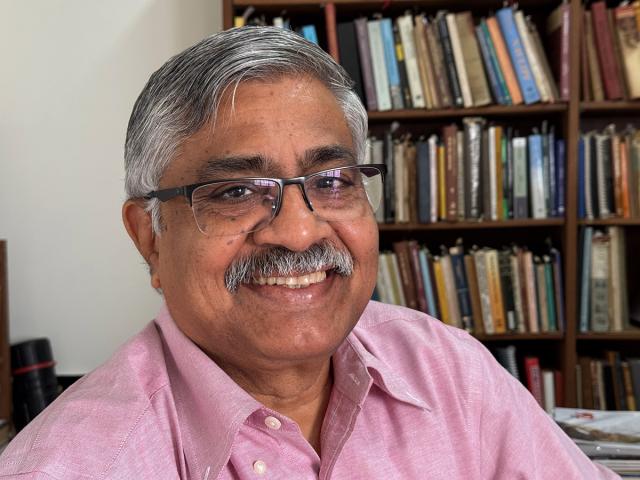
R. Balakrishnan is a retired Indian Administrative Service (I.A.S.) officer, was a close associate of Iravatham Mahadevan, and is the author of a number of books, including Journey of a Civilization Indus to Vagai (2019). The book offers a detailed exposition of the idea that modern Tamil and Dravidian culture have close connections on many levels from language and genetics to the peoples and culture of the ancient Indus civilization. He was interviewed by Omar Khan on January 9, 2025.
Omar Khan: It's great to sit here with you today in Chennai, Mr. Balakrishnan. Thank you so much for taking the time to talk to me. Let's start with telling me a little bit about where you were born and where you grew up and what your parents did.
R. Balakrishnan: Thank you very much. I have a bit of an unusual background. I am the first graduate from my family—not just my family, but my entire surroundings. I was born near Madurai, in southern Tamil Nadu. My mother and father are also from Madurai region. In fact, my father’s ancestral home is near Keeladi. But we have never been there as my father lost my grandfather when he was two months old. There was an epidemic at that time; a village getting wiped out due to cholera was very normal in the 1930s. He was therefore brought up in another area by his mother.
He could have really been educated—I always had a feeling that, had life afforded him, he could have been a good teacher, professor, or lawyer. I wondered what he could have been. But life did not put it that way. He was only able to study up to the 6th standard. Then he went to work for a transport company in the private sector and did it the hard way. My mother came from an agricultural and small business background. But fortunately, we moved to Madurai.
My entire education from school up to post-graduation, was in Madurai city. I was a Tamil-medium student and I decided to study Tamil Literature. During my pre-university course, my parents wanted their son to be either an engineer or a doctor. Even today, that seems to be the norm among parents.
I tried studying science at the pre-university level, but I found it difficult to grasp—mainly because I was a Tamil medium student. My mother tongue is Tamil and suddenly switching to English medium was difficult. There was an issue in comprehension. I realized that my energy would be wasted understanding the language, not the science. I asked myself where I can be number one, or the best? By that time, I was already winning competitions such as debate, essay writing, and poetry at a young age. Recognition in the field of Tamil—something inside told me to do what I felt confident and strong about. So, I decided to study Tamil literature.
In those days, no one would normally venture to study Tamil because there was a perception that there were no job opportunities in it. My parents would worry a lot. But I took an independent decision—even though I had also qualified for the Bachelors courses in Science - both in Botany and Physics. However, I chose B. A. in Tamil. My father had a problem with that, and he did not speak to me for a couple of months. He reconciled later, and I told him that I would not remain unemployed even for a day after graduation. I made that statement with a lot of confidence. I stood first in my university and won a gold medal in my post-graduation.
In my life, certain things have happened in an unusual manner. Normally, if you are the university topper, you're expected to pursue further studies, an M.Phil, then a Doctorate, and go into academia. That was what my professors also expected. But by then, I had questions about the antiquity of Tamil—about names associated with Sangam literature and the things that my classroom couldn't answer. I felt those questions deserved to be pursued further than acquiring a doctorate degree.
So I took an unusual path. A well-known journalist A. N. Sivaraman, a freedom fighter and editor of Dinamani Newspaper belonging to Indian Express Group who was based in Chennai but connected to Madurai—made a visit to my college. I took journalism as an optional subject in my post-graduation diploma, so about 20 students went for a two-week exposure training there. He used to watch me, and I always wondered what impressed him.
At the end of the course, he straightaway asked: 'If I give you a job, will you accept?' I was surprised—what kind of job in a newspaper office? Editor, sub-editor, proofreader? I didn't even ask him what job. I said yes. He replied: 'You didn't even think, didn't even blink. You just said yes.' I must have wanted to do a post-graduation; it didn't matter. He gave me 240 rupees a month—just about 8 rupees a day.” I asked him why he picked me. Later I understood that my body language was the reason and—even today, it's something I pay attention to. Omar Khan: "What year was this?"
R. Balakrishnan: "It was 1980. If I would have joined for a doctorate degree, and the assistance I would have received from the government would have been more than my salary, but I saw this job as a learning opportunity. He made a calculation—bus fare, tea, tickets, all in front of me, and concluded my cost of living was about 7 rupees a day. So he decided to give me 8 rupees, 240 rupees a month, with the condition that for six months I'd work like this. If they liked me, they'd offer me a permanent position; if I liked them, I could stay. But he didn't take more than a month to revise those six months—he contacted me again to make an offer to join as a permanent employee. That's how I started.
Omar Khan: As a journalist?
R. Balakrishnan: Yes, as a journalist. After that, from journalism, I went straight into the Indian Administrative Service. It is a very important and prestigious service in India—the Union Public Service Commission conducts the Indian Civil Service, similar to the federal service in the United States. We are attached to a province but can be called the federal government as well. A lot of prestige is attached to that. Out of 0.7 million or 0.6 million people who take the exams yearly, only about 120 of them make it. The service is constantly adapting to modern times and new challenges, but I consider it a way to select thought leaders.
I was the first person to write this prestigious examination in Tamil language. The right to write in one's own mother tongue or in any Indian language was given in 1979, and I was the first person to use it. I was also the first person who studied B. A. Tamil and M. A. Tamil, ever to make it to the civil services. There was a lot of flutter and discussion. In those days, there was no TV or social media, but all newspapers and magazines covered my achievement. I had the normal expectation that I'd be posted in Tamil Nadu. Even people suggested me to meet the then Chief minister of the federal government, so that my opportunity to be posted in Tamil Nadu would increase, but I didn't do that.
I didn't make any calls; I went straight to my training academy in Mussoorie, in the Himalayas. I told myself that I would be definitely selected for the Indian Administrative Service and could be posted anywhere in India. I was willing to go anywhere, and I ended up in Odisha (previously Orissa). Looking back, I feel that whatever I am doing now might not be possible had I not left Tamil Nadu and worked elsewhere. It broadened my horizon, working with different languages and meeting tribal people.
Omar Khan: How long were you with the IAS?
R. Balakrishnan: I officially retired at the end of 2018 - about 34 years in service. Then I was recalled as Chief Advisor to the Chief Minister of Odisha for another five years—so around 40 years in total, including post-retirement advisory work. On the personal front, I've always approached life by doing what I like, not getting into anything that I'm not familiar with or comfortable. If I'm not strong in mathematics, I won't even touch it; if I'm not athletic, I won't make an attempt. I always relied on my inner calling and guided by the people around me.
I have a very strange background—and people in Tamil Nadu know it. At a very young age, I got into public life. My father was a follower of Kamaraj, former Chief Minister of Tamil Nadu in the 1950s. Kamaraj was known as a kingmaker. He was instrumental in making two Prime Ministers—Lal Bahadur Shastri and Indira Gandhi. My father was devoted to him and involved me in politics at the age of nine or ten.
I gave my first public speech at the age of ten. I travelled with Kamaraj, campaigned during elections. One night, at about 11 pm, Kamaraj spotted me at a village, surprised that such a young boy was talking politics at that hour. He made me sit in his car and scolded me. He said, now that the freedom struggle is over. Now it is only electoral politics. So he advised me to focus on my studies and become an IAS officer. That advice changed my path. I decided to give the IAS exam just once, and if I didn't make it, I'd move on. I succeeded in my first attempt and finally quit politics in 1977.
Omar Khan: Your professional work in Orissa gave you new insights, right?
R. Balakrishnan: Absolutely. Odisha is a microcosm of India's diversity. Tribal groups, Austro-Asiatic languages, Mundari-speaking people, Dravidian speakers—so many distinct communities, all in one State. Nearly 40% of Orissa's population belongs to the scheduled castes and tribes. Working there, dealing with poverty and mineral wealth, taught me about pluralism and the layers of Indian society. I learned Oriya and some tribal languages. In tribal areas, I repeatedly encountered place names that echoed ancient Tamil and its culture. When I visited a village called 'Tamili,' I discovered that local tribals spoke Kuvi, rich in proto-Dravidian elements.
My interest in place names grew—I began to notice patterns—the suffix 'oor,' names ending in 'palli' and 'patti'—recurring both in tribal areas of Orissa and in Tamil literature. These linguistic trails could be markers of migration and cultural connections across India. I started building a database of place names and comparing Sangam-era terminologies with field research. I also studied semantics—the noun and verb forms in words. 'Nadu’, for instance, means 'country,' but as a verb it means 'to plant' or 'to establish.' Linking semantics and settlement patterns was an eye-opener for me.
I pursued this research while working full-time as an administrator. My government jobs were intense, working with—natural disasters, major elections and crisis management. For years, I lived parallel lives—working full-time while researching at night and on holidays. Most colleagues didn't know about my research, and most academicians didn't know I was in the IAS.
Omar Khan: How did you first meet Iravatham Mahadevan and move into Indus studies?
R. Balakrishnan: It is an unusual story. Both Mahadevan and I were in IAS, with about 30 years difference. Years later, when I joined IAS and went to Mussoorie for training. I saw Mahadevan, who was known for his work on the Indus script, came to the academy to deliver a talk. I was assigned to be his escort officer. He quit IAS to join the Indian Express group, Dinamani, which was where I worked earlier. He also introduced a new system at the Indian Express that anyone joining as a journalist had to go through exams and interviews, a civil-service style process. The editor who spotted me was a traditional journalist; he believed in selecting people by instinct, not exams. I didn’t have to take the exam afterall, thanks to that editor’s decision and intervention from higher-ups.
That’s when I met him face to face for the first time. He remembered me from the Indian Express, and we laughed about the exam story. I listened to his Indus script lecture at Sardar Patel Hall and thought to myself, ‘Will I ever come again to this academy to speak on a topic like Indus script?’ I dismissed the thought at the time.
In 1997, I published a paper in English on Place names in Orissa and Chhattisgarh. Mahadevan read it and told me, 'Bala, I think you have a job to do in the Indus Valley. Place names can be useful markers.' He mentioned Asko Parpola and Southworth, who had used Meluha place names as markers. He suggested focusing on Kudal and Madurai, the Maharashtrian place name, and drawing connections among them.
Mahadevan's advice set things in motion. My government work kept me busy, but after the cyclone in 2000, I took charge as Director of Tourism and Culture for Orissa. In the aftermath of the 2000 cyclone, I revived tourism and started researching Konark. I focused on Konark, the Chandrabhaga river, and the sun temples. A sun temple in Multan, Pakistan (‘Mulasthan’) drew my attention; Chandrabhaga river flows nearby. I realized place names traveled with cults—a cluster moving over centuries. I found Sakaldipi Brahmins, sun-worshipping almanac writers, and traced their migrations. I validated these findings by traveling through villages and connecting multiple markers.
I didn’t immediately publish my findings. I always validated my work using known migrations—the Parsis, the Africans, and the Europeans—to test the reliability of place names. Only after thorough comparisons and validations did I begin to share my results, slowly moving towards the Indus-Tamil connection through names like Korkai, Vanji, and Thondi.
Mahadevan’s enthusiasm was a great motivation. Later, Parpola advised me to make my comparative studies more controlled—focusing the database and avoiding spreading the net too wide. His clinical, scientific guidance was invaluable.
Both scholars told me that place names could be reliable markers, though conclusive proof—like a ‘Rosetta Stone’—still eludes us.
Omar Khan: How did your database confirm your hypothesis?
R. Balakrishnan: By searching for Sangam-era Tamil names—especially the obscure ones—I found close matches in the Indus region. Finding ‘Korkai,’ ‘Vanji,’ and ‘Thondi’ was a eureka moment. Over time, 80-90% of the ancient names in my database turned up in the north as well.
I used a two-way litmus test: the names should be unknown in the North (except within the Sangam-Indus context) but emotionally significant for Tamils. This approach let me build a credible case for historical continuity and migration.
Omar Khan: Let’s talk about your ‘rainforest’ metaphor—how does it apply to Indian civilization?
R. Balakrishnan: India is like a rainforest—not a melting pot or a solid bowl. In a rainforest with urban traders, rural farmers, hunter-gatherers, and pastoralists coexisting and depending on each other, just as countless species thrive together. Indian society is layered and organically plural, not uniform or mixed into a single paste.
A melting pot fuses identity into something new; a ‘solid bowl’ preserves only the most elite elements. Indian civilization supports simultaneous diversity and rootedness. Even today, various modes of life coexist.
Omar Khan: There are still critics, like Dr. [Ahmed Hasan] Dani, who look for conclusive proof. How do you respond?
R. Balakrishnan: I respect that view. Ultimately, unless something like a bilingual inscription—a physical ‘Rosetta Stone’—emerges, debate will continue. We build arguments with the strongest evidence available, but absolute certainty remains elusive. Still, the patterns from literature, flora and fauna, and place names are compelling.
Omar Khan: And the Dravidian hypothesis is an ongoing debate?
R. Balakrishnan: Absolutely. The debate over the Dravidian hypothesis and the age of the Indus civilization is now a century old. Each new piece of evidence either advances or refutes it, and opposing claims continue to be made.
Omar Khan: You mentioned the importance of education and literacy in Tamil society. Can you elaborate?
R. Balakrishnan: Literacy and learning were always emphasized in Tamil society. Sangam literature celebrates the learned, regardless of birth or class—poetesses from humble backgrounds are honoured, and education is tied to status and prestige rather than solely to family origin. This emphasis explains why Tamil was the first South Asian language to be printed, and 40% of all the early printed books in the region were in Tamil. The democratization of knowledge began with the printing press and continues through the IT revolution—making literature available on phones and laptops and allowing Tamil learning to spread worldwide.
Omar Khan: Has the IT era accelerated this literary and historical engagement?
R. Balakrishnan: Definitely. The printing press began the democratization of Tamil knowledge, making texts available beyond palaces and temples. Now, with IT, literature, inscriptions, and historical records at everyone’s fingertips, fueling discussion, research, and self-awareness—especially during COVID, when Tamils worldwide debated, lectured, and published. This includes myself.
This technological wave ensures that our history, poetry, and collective knowledge renew themselves with each new generation. I gave over 60 talks, which turned into three books during that period.
Omar Khan: I have been reflecting on the development of literacy in Tamil Nadu and how it compares to other regions. Do you believe that educational priorities shaped Tamil identity as much as language and place names?
R. Balakrishnan: Absolutely. The impulse to value education pervades Tamil history, and it’s not limited to elite classes. In the Sangam literature, even among marginalized groups, women, and potter families, you see an emphasis on learning. The importance of education is spoken repeatedly—a scholar might be consulted by kings, and a learned individual receives extra respect even within their own family. More inscriptions are found in Tamil Nadu than anywhere else in India, and palm-leaf manuscripts abound.
When the printing press arrived, knowledge was democratized—it was no longer confined to temples or wealthy families. The IT revolution took this step further, placing ancient texts, histories, and poetry at everyone’s fingertips. Smartphones and laptops now provide access to the entire corpus of literature, from Sangam texts to Thirukkural.
Omar Khan: How do genetics and modern perspectives alter our view of Dravidian identity?
R. Balakrishnan: Modern genetics shows Harappan ancestry across South Asia, blurring strictly racial definitions. The word ‘Dravidian’ describes the language family, not race. Our scientific institutions should promote inquiry and reasoned debate, and resist outdated or politicized conceptions tied to birth or exclusivist mindset.
Omar Khan: What was Mahadevan’s last advice after years of research?
R. Balakrishnan: In his final months, he argued strongly for dropping the word ‘hypothesis’: he believed the time had come to confirm the Dravidian link outright, given the strength of place name, ritual, and genetic evidence. This shift is now echoed in recent Tamil scholarship.
Omar Khan: What’s the story behind the Roja Muthiah Research Library and the Indus Research Center?
R. Balakrishnan: Roja Muthiah was a signboard artist who amassed a singular literary collection. After his death, the University of Chicago preserved it. The Library now holds over half a million items. The Indus Research Center was founded with the advise of Mahadevan in 1997, and I later succeeded him as honorary consultant. It has become the locus for contemporary Indus and Tamil academic connections and memory.
Omar Khan: That is fascinating. Thank you for sharing your perspective and very much personal and professional insight. I really appreciate it.
R. Balakrishnan: Thank you. I appreciate the chance to speak at length about these subjects. It's always rewarding to reflect on both the past and our journey forward.