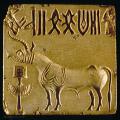
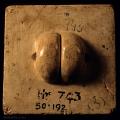
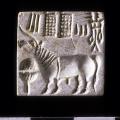
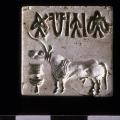
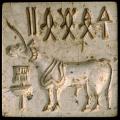
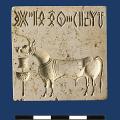
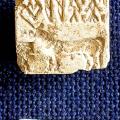
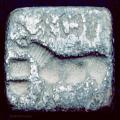
Large square unicorn seal with perforated boss on the back (26). The unicorn is the most common motif on Indus seals and appears to represent a mythical animal that Greek and Roman sources trace back to the Indian subcontinent. A relatively long … >
Large square unicorn seal (25.) with perforated boss on the back (26). The unicorn is the most common motif on Indus seals and appears to represent a mythical animal that Greek and Roman sources trace back to the Indian subcontinent. A relatively l… >
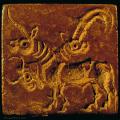
Square seal with multiple headed animal depicting three important totemic animals: the bull, the unicorn, and the antelope. All three animals are seen individually on other seals along with script, but this seal has no script. Material: gray brow… >
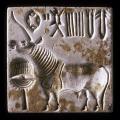
A steatite unicorn seal from Harappa with Indus script. This seal was found in the central area of Mound E and dates to Period 3B or early 3C, around 2450-2200 BCE. When pressed into clay the impression will be reversed. Since the Indus script may h… >
A square steatite unicorn seal with a unique inscription was found in the street debris on the inside of the city wall. The two sets of signs on the right hand side of the seal would appear in reverse, i.e. be on the left, when it was pressed into c… >
Unicorn seal from Trench 37, which lies to the east of the "Granary." This type of seal comes from levels dating to Harappa Phase Period 3B. Similar seals were found near the "granary" in 1997. >
Intaglio seal (H97-3433/7617-01) with script and unicorn motif found in Trench 41NE in 1997. This seal dates to approximately 2200 BCE, at the transition between Harappa Periods 3B and 3C. >
Large unicorn seal (H99-4064/8796-01) found on the floor of Room 591 in Trench 43, dating to late Period 3C. This is one of the largest seals found from any Indus site. >