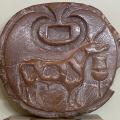
Among the most unique of ancient Indus objects, it inspired Dr. Kenoyer to surmise that "perhaps the most intriguing aspects of the ancient Indus culture are the religion and politics, which appear to have been closely intertwined." >
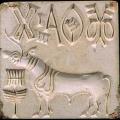
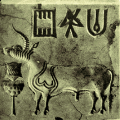
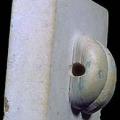
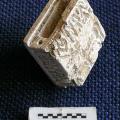
This seal from Mohenjo-daro measures 29 mm (1.14) inches on each side and is made of fired steatite. Steatite is an easily carved soft stone that becomes hard after firing. On the top are four "pictographs" of an as yet undeciphered Indus script, on… >
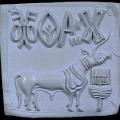
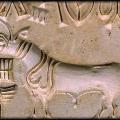
Seals were used to make a sealing, or positive imprint, like this modern resin one made from the original seal. Sealings were used in ancient times for trade. They would be made on ceramics or the clay tags used to seal the rope around bundles of go… >
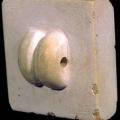
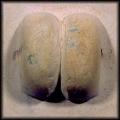
Mackay continues (p. 377 in Marshall 1931): "The boss was then carefully rounded off after the groove that always runs across its centre had been roughly made by a V-shaped cut. The rounding of the boss was apparently done with a knife and finish… >
Mackay writes that most of the bosses on the backs of seals had the same size and shape. The perforation always runs in the direction of the animal's body, to help keep the seal upright when worn around the neck. The boss is centered on the back … >
If the figure does represent a cattle species, the clearly carved collar, garland and necklace could help explain its function. Sacrificial animals in village India are often garlanded and decorated similarly today. The Rg Veda speaks of the capture… >
This unicorn seal was also discovered during the late 1927-31 excavations at Mohenjo-daro. One theory holds that the bull actually has two horns, but that these have been stylized to one because of the complexity of depicting three dimensions. Howev… >
In addition to any commercial functions, the seal may also have designated a position of authority. The motif on the seal could also have been an amulet or charm. The seal itself was probably worn around the neck, with a chord passed through the … >