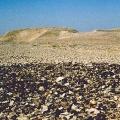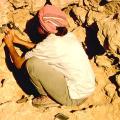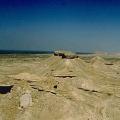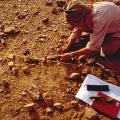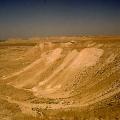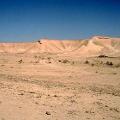
The excavation of one of these quarry pits was carried out in February 1995. The excavation took place over a small 2 by 3 meter area facing the Indus Valley. >
Around the Tomb of Adam Sultan many late Paleolithic workshops were found. Some were of impressive diameter. The most characteristic tools are subpyramidal bladelet cores. The sites are attributed to the Late (Upper) Paleolithic period on the basis … >
The surface of one of the late Palaeolithic workshops discovered in the survey of February 1997. One pyramidal, bladelet core is in the middle of the slide. >
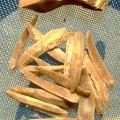
Flakes of various shades of agate, carnelian, jasper, chert, and lapis lazuli indicate the range of raw materials being processed in this part of Harappa during the Ravi phase. All of these raw materials were brought to the site from distant res… >
Excavation of site 862 revealed that the pit had been used by Harappan miners down to a depth of 1.30 meters where the flint vein was encountered. From this pit, a radiocarbon reading of a small charcoal fragment indicated that the mine was explo… >
During the Kot Diji phase many new types of raw material were brought to Harappa for making ornaments and tools, indicating expanded trade networks and suggesting a growing population of consumers. A wide variety of stones reflecting different s… >