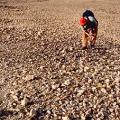
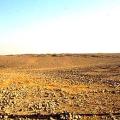
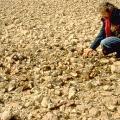
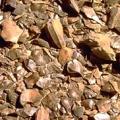
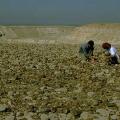
Around the quarries, thousands of flint artefacts were found lying on the surface. This shows that peliminary chipping of the artefacts took place on top of the mesas, or flat limestone terraces. >
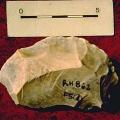
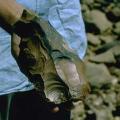
An almond shaped pre-core recovered from the bottom of quarry pit 862. A pre-core is the working stage preceding the manufacturing core. Any nodule from which a few flakes have been removed in order to obtain a flat surface from which to start the m… >
The presence of Harappan flint workshops in the hills close to Rohri had been discovered by Bridget Allchin in 1975. The impressive mining activity in the hills is particularly well-represented near Shadee Shaheed. The 1993-96 surveys discovered mor… >
Southwest of the hills lies the famous pre-Harappan and Harappan site of Kot Diji. From the surface of the site, it is very easy to collect flint artefacts obtained from Rohri Hills raw material. The quarry pits investigated so far belong to the … >
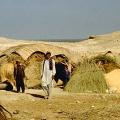
The wadi bottoms of the Rohri Hills are today seasonally inhabited by groups of Baluchi families. They work in service to contractors to dig up the limestone terraces, which seriously damages the unique ancient archaeological features of the hills. >
The cores are of a type typical for Harappan culture, both conical and elongated. The blades have been struck off with the pressure technique. This involves pressing the surface of a flint or flake with a soft-pointed instrument. In Europe, the soft… >
The Acheulian workshop of Ziarat Pir Shaban 1 (ZPS1). The Acheulian is a Paleolithic Culture (about 50,000 B.C.) characterized by the presence of bifaces and handaxes. Very little is known about the culture. Excavations were carried out here in Marc… >
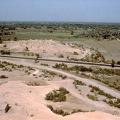
During the surveys, a Castiglioni Brothers helium balloon was employed to take photographs from various altitudes. Thanks to this technique, 800 slides and black and white photographs were taken in five days. >
The exact date of the Ziarat Pir Shaban Late Palaeolithic site is difficult to establish. It is reasonable to attribute it to the start of the middle Palaeolithic period, or some 100,000 years ago. >