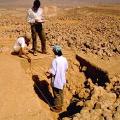
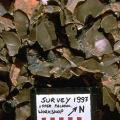
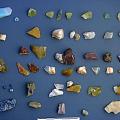
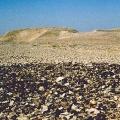
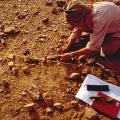
The surface of one of the late Palaeolithic workshops discovered in the survey of February 1997. One pyramidal, bladelet core is in the middle of the slide. >
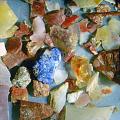
Flakes of various shades of agate, carnelian, jasper, chert, and lapis lazuli indicate the range of raw materials being processed in this part of Harappa during the Ravi phase. All of these raw materials were brought to the site from distant resourc… >
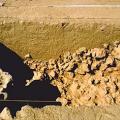
Excavation of site 862 revealed that the pit had been used by Harappan miners down to a depth of 1.30 meters where the flint vein was encountered. From this pit, a radiocarbon reading of a small charcoal fragment indicated that the mine was explo… >
During the Kot Diji phase many new types of raw material were brought to Harappa for making ornaments and tools, indicating expanded trade networks and suggesting a growing population of consumers. A wide variety of stones reflecting different stage… >
The Indus River as it flows in the Bukkur Gorge between the towns of Sukkur and Rohri some 20 kilometers (km) north of the excavation areas. In the background is the temple island of Sadhbela. >
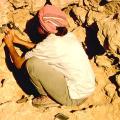
Soil samples were taken for thin section analysis in various areas of the hills to try to understand the climactic variations that took place in the area before, during and after the rise of Harappan culture. >
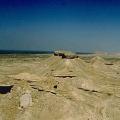
The Rohri Hills as they appear along the western fringe of the plateau, facing the fertile Indus Valley, where most of the Harappan flint quarries and workshops have been discovered. (The shadow is from the helicopter.) >
Four Harappan workshops were excavated, including site 480 from which more than 35,000 artefacts were collected. Most of them were debitage flakes, but also included narrow blades, bladelets and accurately made bullet cores. >