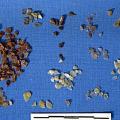
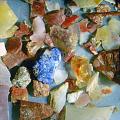
After wet screening, the Ravi phase microdebitage, larger flakes, broken drills, and even microbeads are sorted according to type of artifact and kind and color of stone. >
The earliest evidence for normal weave textiles at Harappa is found in this impression on a Ravi Phase bead from Harappa, dating to around 3300 BCE. This fragment is only 1 cm long. Normal weave denotes interlacing single threads (one thread over/un… >
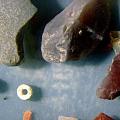
Tiny steatite microbeads (less than 1mm in diameter) such as those seen here were probably perforated with a sharpened copper wire, while stone drills with larger tips were used for carnelian, lapis, and amazonite beads. >
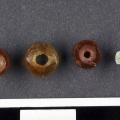
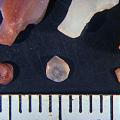
These beads from the Ravi Phase (3300-2800 BCE) at Harappa have been made from carnelian and amazonite (right hand bead). The raw material used to make these beads was brought to the site from source areas probably in Gujarat, over 900 km to the sou… >
Flakes of various shades of agate, carnelian, jasper, chert, and lapis lazuli indicate the range of raw materials being processed in this part of Harappa during the Ravi phase. All of these raw materials were brought to the site from distant res… >
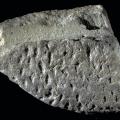
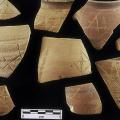
Many sherds inscribed after firing have single geometric signs. This collection of Early Harappan sherds from Periods 1 and 2 (c. 3300-2800 BCE) show a range of geometric signs that are roughly similar to later signs in the Indus script. >
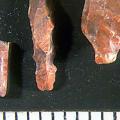
During drilling, the tips of agate drills become hot and often spall off. Fine screens allow the collection of the spalled drill tips, the finding of which confirms that drilling as well as shaping of beads was done in this area of the site during t… >
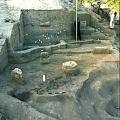
View of Harappa Mound AB Trench 39N from the North showing the earliest Ravi [Aspect of the Hakra] phase occupation levels (Period IA, ca. 3300 BC). These levels revealed traces of post molds from houses that were oriented N-S/E-W. >
Jasper drill bits were used for drilling carnelian and amazonite beads during the Ravi and subsequent phases at Harappa. On the left are two snapped drill tips while on the right is a broken drill base. All are from the Ravi phase. >
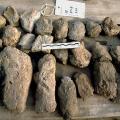
Ravi phase hand-formed (not in molds) mud-bricks were found in the early levels mixed with ash and broken pieces of pottery. They may originally have been part of a firing structure or kiln. >