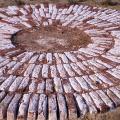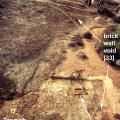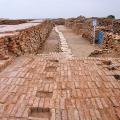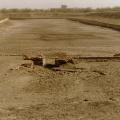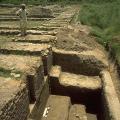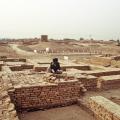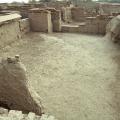
Circular platforms in the southwestern part of Mound F excavated by M.S. Vats in the 1920s and 1930s, as conserved by the Department of Archaeology and Museums, Government of Pakistan. >
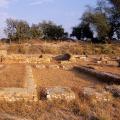
The UM excavations conducted by Dr. G. F. Dales in 1964-65 exposed a massive mud brick platform on top of which were built numerous brick buildings separated by narrow lanes. The pottery excavated from this area was used to develop the most comprehe… >
The circular platform excavated by Wheeler in 1946 (left) and the one excavated by HARP in 1998 (right). Both of these platforms were found inside small square rooms that originally had baked brick walls, subsequently removed by brick robbers (Trenc… >
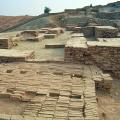
The UM excavations conducted by Dr. G. F. Dales in 1964-65 exposed a massive mud brick platform that was used to raise a group of brick buildings several meters above the street level which was seen in the foreground. The street was approximately se… >
Detail view of the HARP-excavated platform in Trench 43 with Wheeler's platform to the east (toward the top of the image). Note the mud-brick wall foundations that surround each platform to the east, south, and west (the north walls remain unexposed… >
A large section of the mud brick platform in the UM Area was removed to be sure that it was not concealing other brick structures. The fired bricks of the upper buildings measured 7 x 15 x 29 cm (approximately 1:2:4 ratio), while those of earlier bu… >
A large concentration of straw impressions was found in one part of the floor next to the platform, but there is no evidence of chaff from processing grain as was suggested by earlier excavators (Trench 43). >
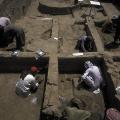
Jonathan Mark Kenoyer excavating and sampling the sediments associated with the HARP-excavated platform, which was partly robbed of baked bricks during the Harappan period itself (Trench 43). Pottery found under the platforms permits them to be assi… >