Kot Diji Phase (3300-2600 BCE) related sites and objects. This pre-ancient Indus culture is named after the site of Kot Diji on the east bank of the Indus River in Khairpur province, Sindh, and was excavated between 1955 and 1957.
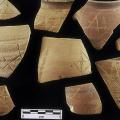
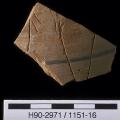
Many sherds inscribed after firing have single geometric signs. This collection of Early Harappan sherds from Periods 1 and 2 (c. 3300-2800 BCE) show a range of geometric signs that are roughly similar to later signs in the Indus script. >
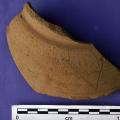
This sign was carved onto the pottery vessel after it was fired and may indicate the type of goods being stored in the vessel or the owner of the vessel itself. Another possible explanation is that this symbol represents a deity or spirit to which t… >
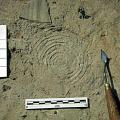
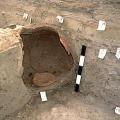
At the bottom of the Kot Diji phase storage vessel was a broken lid and charcoal that was used for dating the fill inside the pot. There is a 91 percent chance that the date obtained from this charcoal falls between 2602 and 2445 radiocarbon years B… >
On some sherds, two signs of the Early Indus script (Kot Dijian Phase) appear together. The complete shapes of these signs can be seen on later seals carved with the Indus script (see 43). The sign on the left eventually becomes one of the most com… >
Three signs are inscribed on this rim sherd of the Early Harappan Period (Kot Dijian Phase), dating to around 2800 BCE. Two of the signs appear to be pictographs for a bow and arrow, but they probably had some other meaning that was defined by the d… >
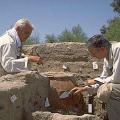
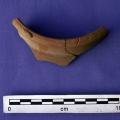
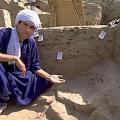
In Kot Diji phase sediment that had washed into the street, Brad Chase discovered a button seal (close-up in 44) quite similar to seals recovered from the site of Rehman Dheri in to the Northwest in the Gomal Valley. >
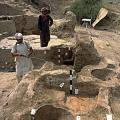
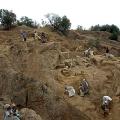
Harappa Mound AB, Trench 39N, showing the Kot Diji phase (Period 2, ca. 2800-2600 BC) and later levels during excavation. The surveying tripod is standing next to two Kot Diji phase kilns, and the rod is leaning against a later Harappa phase baked b… >